
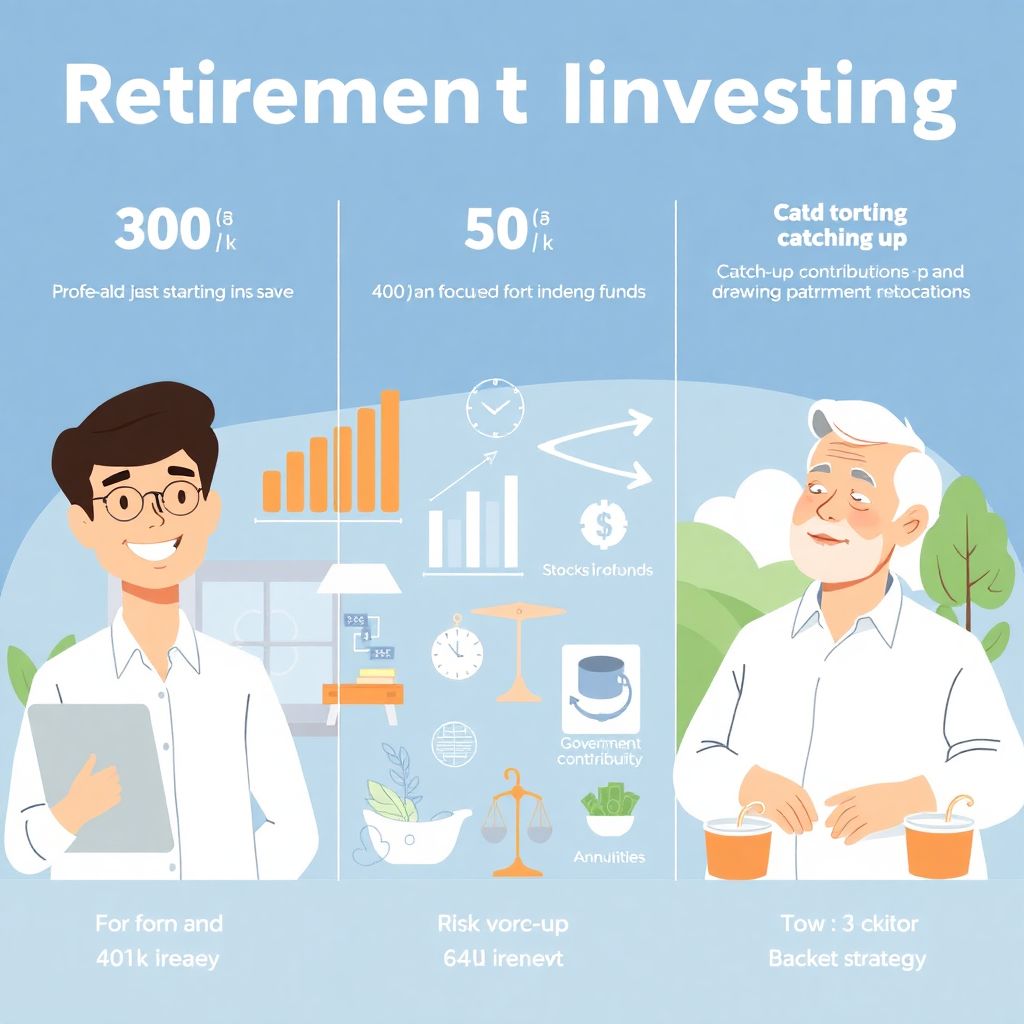
Retirement planning sounds so distant when you’re 30, and painfully urgent when you’re 55. The tricky part is that the same financial system has to work for both of those people. This practical guide walks through the landscape of retirement investing in plain English, explains where the big options came from, and shows how to mix and match them without losing your mind or your money.
You don’t need to become a Wall Street analyst. But you do need to understand which tools exist, what they roughly cost, and how they behave in good and bad markets. Let’s unpack that step by step.
—
Historical background: how we got this messy system

For most of the 20th century, retirement in the US and many other countries revolved around pensions and state benefits. Your employer promised a paycheck for life, and governments supported the rest. That began breaking down in the 1970s–1980s as companies realized how expensive guaranteed pensions really were. In the US, the modern 401(k) plan was born in 1978 almost by accident, when a section of the tax code allowed employees to defer salary into investment accounts. Employers loved shifting risk off their balance sheets, and workers liked the idea of “owning” their retirement money.
Fast-forward to today: according to the Investment Company Institute, total US retirement assets jumped from about $33.6 trillion at the end of 2022 to roughly $39 trillion by the end of 2023, as markets recovered from the 2022 slump. Early 2024 data show further growth driven by higher equity markets and continued contributions. That’s huge progress on paper, but it also means individuals now carry most of the risk that pension funds used to handle. Understanding the best retirement investment options is no longer a bonus skill; it’s a survival skill.
In parallel, life expectancy quietly changed the math. In 1960, an average 65‑year‑old American might plan for 10–12 years of retirement. By the early 2020s, that horizon stretched closer to 20 years on average, and much longer for healthier and higher‑income people. That extra decade of life has to be funded by investments that can outpace inflation, not just by savings under a mattress. Speaking of inflation, US CPI peaked at about 8% in 2022, cooled to roughly 3–4% in 2023, and hovered in the 3% range during 2024. Those swings are exactly why parking everything in cash is usually a bad long‑term bet.
—
Basic principles: the foundation before picking products
Before arguing about IRA vs 401k which is better, it helps to anchor on a few principles. First, the goal isn’t to “beat the market”; it’s to fund a specific lifestyle over a specific time horizon. That means you need a rough number: how much per month, in today’s money, you’d like to spend in retirement. Even a ballpark – say $3,000 versus $7,000 – radically changes how aggressive your investments must be and how early you need to start.
Second, risk and return are joined at the hip. Over long periods, stocks have historically outperformed bonds and cash, but they can also drop 20–30% in a bad year, as 2022 reminded everyone. Bonds usually move less dramatically but may lag when inflation spikes. For most people, a diversified mix of both is the core of sensible retirement investment strategies for 50 year olds, 30‑somethings, and even late starters in their 60s. The mix shifts with age and circumstances, not with headlines.
Third, costs matter much more than most people think. A 1.5% fund fee sounds tiny, but over 30 years it can eat away tens of thousands of dollars compared with a low‑cost index fund charging 0.05–0.10%. When Fidelity and Vanguard publish those “average 401(k) balances” every year (Fidelity reported about $103,900 in late 2022 rising to roughly $118,600 by the end of 2023), a big part of the gap between “typical” savers and top performers comes from steady contributions plus low costs, not magic stock picks.
Finally, taxes are not just a footnote; they’re part of your return. A 7% pre‑tax return in a taxable account may be less valuable than a 6% return sheltered in an IRA or 401(k), depending on your bracket and future withdrawals. When you think about how to invest for retirement, treat tax advantages as one of the levers you pull, alongside risk level and time horizon.
—
Understanding the main account types
Tax‑advantaged accounts: the core tools
Most retirement systems offer some version of a tax‑favored account where your investments can grow either tax‑deferred or tax‑free. In the US, those are 401(k)s, 403(b)s, and IRAs. In other countries, you might see things like SIPPs (UK), RRSPs (Canada), or superannuation funds (Australia). The logic is the same: governments want you to save, so they offer a tax break to nudge you.
In the US context, workplace plans like 401(k)s typically allow higher annual contribution limits than IRAs and may include employer matching. That “free money” match – often 3–6% of your salary – is one of the strongest guaranteed returns you’ll ever see. IRAs, on the other hand, give you more control over where and how you invest, with a broader menu of funds and often lower costs if you shop around. Deciding where to put your next dollar is less about IRA vs 401k which is better in some abstract sense and more about which account still has space, match opportunities, and good investment options for your situation.
Taxable accounts: the flexible backup
Once you’ve used up tax‑advantaged space, or if your country offers limited tax shelters, regular brokerage accounts fill the gap. These accounts don’t have special tax breaks, but they do offer flexibility: no contribution limits, no age‑based withdrawal rules, and easy access for big pre‑retirement goals like buying a home or funding a career break.
In practice, many high‑savers end up with a mix: tax‑sheltered accounts for the long‑term retirement base, and taxable accounts for extra investing or earlier financial independence. When done thoughtfully, this combination allows you to decide which accounts to tap first in retirement, aiming to keep your tax rate low over multiple decades instead of just one year.
—
What can you actually invest in?
Stocks, bonds, and funds: the building blocks

Most retirement investing is done through pooled vehicles: mutual funds and exchange‑traded funds (ETFs). These funds hold baskets of stocks and/or bonds so that you don’t have to pick individual companies. Broad index funds that track large markets – like “total US stock market” or “global ex‑US stocks” – have been popular because they’re cheap, diversified, and have delivered solid long‑term returns.
Bonds, whether via bond funds or individual issues, play the “smoother ride” role. They usually provide income and help cushion stock market crashes. After years of low yields, 2022–2023 brought back more reasonable bond interest rates as central banks hiked rates to fight inflation. That hurt bond prices in the short run but improved prospective returns for new investors. For many people in their 50s and 60s, shifting part of the portfolio into higher‑quality bonds is a way to reduce the odds of having to sell stocks during a downturn just to pay bills.
Target‑date and balanced funds: autopilot options
If you don’t want to build your own mix, target‑date funds are a common answer inside workplace plans. They automatically adjust your stock/bond mix as you approach a specific retirement year, say 2045 or 2055. In 2023, these funds continued to attract large inflows, particularly from younger employees who set their contribution once and rarely change it. Balanced funds (often 60% stocks, 40% bonds) take a simpler, one‑size‑fits‑many approach.
Are they perfect? No. Different providers use different “glide paths” and risk levels; some stay aggressive longer, others become conservative too early. But for people who might otherwise sit in cash or jump between hot funds, a simple target‑date or balanced fund is often much closer to the best retirement investment options than ad‑hoc guessing.
—
Examples of implementation at different ages
In your 30s and early 40s
Imagine Alex, 35, earning $70,000. Their company offers a 401(k) with a 4% match and decent index funds. A practical plan: contribute at least 4% to get the full match, aim for 10–15% total as income allows, and choose a low‑fee target‑date fund or a DIY mix of broad stock indexes plus a small slice of bonds. At this age, the main battle is consistency: building the habit, not obsessing over micro‑optimization.
Between 2022 and 2024, a lot of 30‑somethings saw markets swing hard, then recover strongly. Those who stuck with contributions through the 2022 downturn were rewarded when balances grew in 2023–2024 as stocks rebounded. The lesson: set a reasonable stock‑heavy allocation and automate contributions so you’re buying when markets are up and when they’re down, without overthinking every headline.
Retirement investment strategies for 50 year olds
Now picture Maria, 52, who woke up in 2023 realizing retirement is closer than it feels. She earns $110,000, her kids are almost out of the house, and her combined 401(k) and IRA balances are around $250,000. For her, retirement investment strategies for 50 year olds tilt toward risk management without abandoning growth. That might mean a 60–70% stock, 30–40% bond allocation, focusing on low‑cost funds, and increasing contributions using “catch‑up” limits if her country allows them.
The 2022–2023 inflation spike also pushed many 50‑somethings to rethink cash. Keeping 6–12 months of expenses in high‑yield savings or short‑term bonds for emergencies is smart, but leaving several years of retirement money in low‑interest accounts often means losing ground after inflation. For Maria, gradually shifting from company stock or concentrated bets into diversified funds is usually more impactful than trying to find a miracle high‑yield product.
Nearing or in retirement: seniors’ priorities
For seniors, the question changes from “How fast can this money grow?” to “How reliably can it pay me?” The best retirement plans for seniors tend to blend guaranteed income (government benefits, pensions, possibly annuities) with flexible investment accounts. Someone in their late 60s might keep 40–60% in stocks for long‑term growth, with the rest in bonds and cash to cover 5–10 years of expected withdrawals.
In 2023–2024, surveys from major providers showed more retirees using “bucket” strategies: one bucket of cash and short‑term bonds for near‑term spending, another of intermediate bonds, and a long‑term growth bucket in stocks. This structure helps retirees avoid panic‑selling stocks in bad markets because their next few years of withdrawals are already covered in safer assets.
—
Common misconceptions about retirement investing
One common myth is that you need a lot of money before it’s “worth” investing. In reality, many 401(k) plans allow contributions as low as 1% of pay, and most brokerages let you start IRAs with small monthly transfers. Thanks to compounding, someone who started with $200 per month in 2022 and stuck with it into 2024, even through market volatility, is already far ahead of the person who waited for the “perfect time.” Markets rarely feel safe when they’re cheap.
Another misconception is that there’s a single magical answer to “how to invest for retirement.” People ask for one best fund, or one perfect percentage. The truth is more boring: several different approaches can work as long as they share core traits – diversification, reasonable costs, appropriate risk level, and tax‑aware use of available accounts. Arguments online about the absolute best retirement investment options often ignore the basics: are you actually saving enough, and are you sticking to a plan when markets swing?
Finally, many seniors believe they must avoid stocks entirely once they retire. That sounds safe but can backfire over a 20‑ to 30‑year retirement, especially after seeing how inflation behaved from 2022 to 2024. A portfolio that’s 100% in cash and short‑term bonds might keep you calm today but may not keep up with living costs tomorrow. A more nuanced approach – some growth assets, some income assets, and a clear withdrawal strategy – tends to serve retirees better than any all‑or‑nothing stance.
—
Putting it all together
Understanding your investment options for retirement is less about memorizing jargon and more about fitting a few key tools into your specific life: tax‑advantaged accounts first, simple diversified funds as the core, plus a risk level that matches your age and goals. Whether you’re just starting, catching up in your 50s, or already retired, the ingredients are remarkably similar.
You don’t have to predict the next three years of market returns. You only need a clear structure you’re willing to keep using through up years like 2023 and nervous ones like 2022. If you can combine steady saving, sensible diversification, attention to fees, and basic tax planning, you’re already well ahead of most people trying to navigate retirement investing on guesswork.