

Why Long-Term Care Planning Matters More Than You Think
Most people secretly hope they’ll “just never need” long‑term care. Statistically, that’s wishful thinking. Roughly 50–70% of people over 65 will need some form of ongoing help with daily activities like bathing, dressing or managing medications. That help can be at home, in assisted living, or in a nursing facility – and none of it is cheap. The uncomfortable truth: one year in a decent nursing home can easily cost more than a new car, and you might need several years. Learning how to plan for long term care costs with a clear head isn’t about pessimism, it’s about buying yourself options, dignity and less drama for your family when health issues hit.
Long-term care planning is basically “future you” risk management.
Key Terms: Speak the Same Language as the Insurers
Before diving into strategies, let’s nail down the jargon you’ll see when you start to compare long term care insurance plans or talk to advisors. Think of this as a mini‑glossary you can actually use in real conversations.
What Is Long-Term Care, Really?
Long‑term care (LTC) is ongoing help with “Activities of Daily Living” (ADLs): eating, bathing, dressing, toileting, transferring (moving from bed to chair) and continence. You’re usually “LTC‑eligible” when you can’t do at least two of those ADLs on your own, or you have cognitive impairment (e.g., advanced dementia) that makes it unsafe to live independently. That care might come from paid professionals or family, at home or in a facility. It’s not about “getting cured”; it’s about maintaining quality of life when independence fades and you need steady assistance rather than short‑term medical treatment.
What Long-Term Care Insurance Actually Covers
Long‑term care insurance is a policy that pays a daily or monthly amount if you meet that LTC‑eligible definition. It can help cover home health aides, adult day care, assisted living, memory care, or nursing homes. Coverage is triggered when a licensed professional certifies you can’t perform ADLs or you have serious cognitive decline. When you see long term care insurance quotes online, you’re usually adjusting four knobs: daily benefit (how much per day), benefit period (how long it will pay), elimination period (how long you self‑pay before benefits start) and inflation protection (how the benefit grows over time). Those four knobs control both your premium and how much real protection you’re buying.
Other Essential Definitions
A few more terms you’ll run into: “Elimination period” is basically your deductible in days – 30, 90, sometimes 180 days you pay for care before insurance kicks in. “Benefit pool” is the total maximum the insurer will pay over the life of the policy, often expressed as a multiple of monthly benefit (e.g., 4 years). “Inflation rider” means your benefit grows each year by a fixed percentage, like 3%, so your coverage doesn’t shrink in real terms as care costs rise. “Hybrid” policies combine life insurance with LTC benefits; if you never need care, your heirs get a death benefit, which can feel less like “use it or lose it” and more like repositioning savings.
Start with a Simple Reality Check, Not a Product Pitch
Before you even look at long term care insurance quotes, do a brutally honest baseline: what would happen if you needed care tomorrow? Picture it: who would show up first? A spouse? An adult child who lives in another city? A professional aide? Where would you want to live if walking and driving became difficult – in your current home, downsized condo, or closer to family? And what assets and income streams do you already have – pensions, Social Security, investments, rental income? This thought experiment is uncomfortable, but it’s the only way you’ll design a plan that fits your life instead of defaulting to whatever an agent happens to sell.
Now let’s turn that reality check into some numbers.
Text Diagram: Your Personal LTC Risk Map
Imagine three circles that overlap like a Venn diagram:
– Circle A: “Health & Family History” – longevity, dementia in the family, current conditions.
– Circle B: “Finances” – savings, income, housing, debt, risk tolerance.
– Circle C: “Support Network” – spouse health & age, kids nearby or far, willingness to help.
Where all three circles overlap is your “LTC Strategy Zone”. If you have high health risk, modest finances and a weak support network, you’re in the “must plan aggressively” corner. If you’re wealthy with strong family backup and low health risk, you might accept more self‑insurance. Draw this out on paper; it forces you to see your situation as a system, not just a price tag on a policy.
Step 1: Estimate Your Realistic Care Budget
Knowing how to plan for long term care costs starts with ballpark math, not spreadsheet perfection. Look up current costs in your area: home health aide (hourly), assisted living (monthly), nursing home (monthly). Then assume at least 3%–4% annual inflation in care costs. If today your local assisted living runs $5,000 a month, in 20 years at 3% inflation it’s closer to $9,000. Now ask: “If I had to pay $9,000 a month for three years, could I cover that without wrecking my spouse’s lifestyle or wiping out inheritance I care about?” If the honest answer is no or “only barely”, you’ve just defined your planning gap – the risk you want to transfer or mitigate.
Short version: you don’t need to fund every imaginable scenario, just the ones that would truly damage your family’s finances or freedom of choice.
Text Diagram: From Scenarios to Numbers
Visualize a vertical ladder:
– Rung 1: “Light help at home (8–10 hours/week)” – lowest cost.
– Rung 2: “Daily home care (4–8 hours/day)” – medium cost.
– Rung 3: “Assisted living” – higher, predictable cost.
– Rung 4: “Nursing home / memory care” – highest cost.
Write your best guess of monthly cost next to each rung, then circle the rung that feels like a *likely* scenario given your family history. Plan primarily for that rung plus a buffer, instead of trying to fully finance the absolute worst‑case top rung for many years.
Step 2: Decide What You’re Willing to Self-Insure
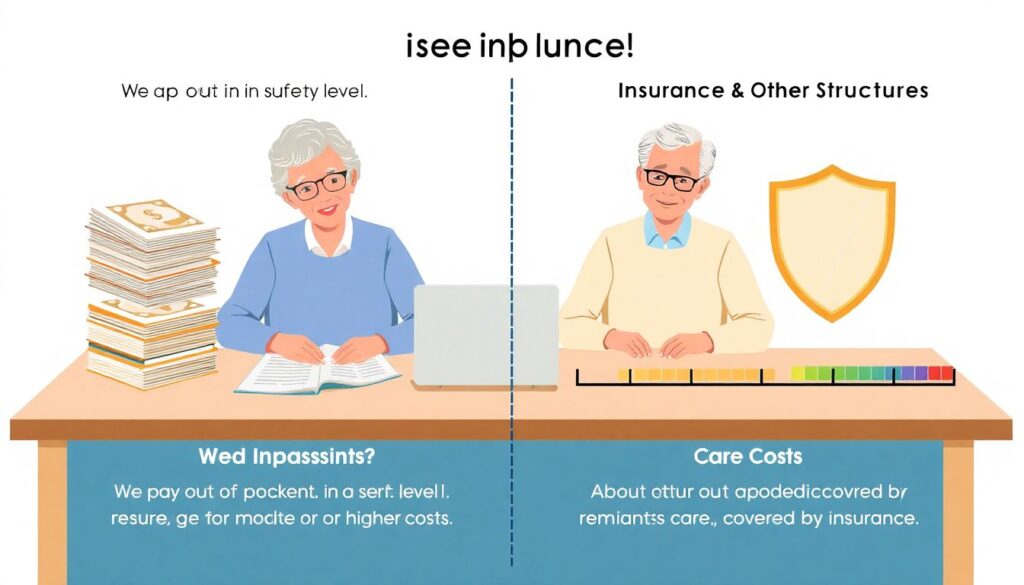
Self‑insurance means you – not an insurer – agree to pay out of pocket up to a certain level. If you’ve saved well or have solid pensions, you might decide, “We’ll handle two years of moderate care from our own assets, but anything beyond that should be backed by insurance or other structures.” This is a subtle but powerful mindset shift: instead of asking, “Can I avoid long-term care insurance?” you ask, “How much risk am I comfortable intentionally keeping?” That transforms shopping from fear‑based to strategic. You measure premiums against a clear self‑insurance threshold rather than guessing in the dark.
Self‑insurance isn’t all‑or‑nothing. You can mix self‑funding the early years with protection for catastrophic, multi‑year scenarios that could happen with dementia or severe strokes.
Unconventional Move: Team Up with Siblings or Adult Children
One underused idea: treat your family as a micro‑insurance pool. Suppose you and your two siblings each agree to set aside a specific amount monthly into separate, earmarked investment accounts with a written family agreement: “We will use these funds first if any of us need long‑term care, before touching houses.” You’re essentially building a family‑level risk pool. It’s not legally an insurance policy, but it can reduce pressure to over‑buy coverage individually, and it aligns everyone’s incentives to support each other and make thoughtful care decisions.
Step 3: Where Insurance Fits – and Where It Doesn’t
When you start exploring policies or visiting long term care financial planning services, resist the urge to ask “What’s the cheapest premium?” Instead ask, “Which slice of risk am I trying to transfer?” Traditional policies shine at providing a tax‑favored stream of money if you need help later, but they can feel painful if you pay for years and never claim. Hybrid products with a life‑insurance or annuity component solve that psychological hurdle but usually require more upfront cash. Depending on your age and health, sometimes a hybrid, sometimes a lean traditional policy, and sometimes no policy at all can be rational – the trick is matching it to your risk map and self‑insurance comfort.
Let’s ground this with an example.
Example: Two Couples, Two Very Different Solutions
Couple A is in their early 50s, both healthy, with moderate savings and no kids nearby. Their biggest fear is becoming a burden. They get long term care insurance quotes for a mid‑level traditional policy with strong inflation protection, aiming to cover a good assisted‑living facility for 3–4 years. Couple B is in their late 60s, already wealthy, with paid‑off housing and adult children willing to help. After they compare long term care insurance plans and factor in their portfolio, they decide not to buy a policy at all; instead, they earmark one rental property and a chunk of bonds specifically as their “care fund” and document that in their estate plan. Two very different answers – both logical for their context.
How to Compare Long-Term Care Insurance without Losing Your Mind
When you compare long term care insurance plans from different carriers, focus on function, not marketing fluff. First, look at the definition of “benefit triggers” (how the policy decides you’re eligible). Next, analyze: daily or monthly benefit, benefit pool size, elimination period, and whether benefits can be used for home care as flexibly as facility care. Monthly benefit structures can be more forgiving than strict daily caps, because real‑life care is rarely perfectly even day to day. Also watch for whether premiums are guaranteed or can be increased for your class of policies – rate hikes are a real thing in this market.
Also, don’t get hypnotized by brand names alone.
Comparing Insurers vs. Alternatives
The best long term care insurance companies tend to have strong financial ratings, transparent histories of rate changes, and customer service that actually helps families navigate claims. But compare them not only against each other, but also against non‑insurance alternatives: purpose‑built investment accounts, home equity lines of credit, or even selling a large, maintenance‑heavy home for a smaller place and freeing up capital. You might find that a slightly smaller policy plus a home‑equity strategy beats a “maxed out” policy from a top‑rated insurer, especially if you value flexibility. In other words, the competitor to Policy A isn’t just Policy B – it’s also your own balance sheet.
Using Financial Planning Services without Giving Up Control
Good long term care financial planning services don’t start with a product; they start with a conversation about your lifestyle, values and fears. Use professionals as architects, not salespeople. Ask them: “Show me three different strategies for my situation: one that uses primarily insurance, one that relies more on assets and home equity, and one hybrid approach. Walk me through pros, cons, and tax angles.” If they can’t do that, or they push a single carrier right away, treat that as a red flag. A proper planner will also bring Medicaid rules, tax deductions and estate planning into the picture so you’re not optimizing one area while accidentally breaking another.
You’re not outsourcing decisions; you’re renting specialized brains while keeping veto power.
Unconventional Move: Design a “Living LTC Playbook”
Ask your planner (or do this yourself) to create a simple, written “LTC playbook” your family can follow if something happens. It might say:
1) Which assets to tap first,
2) When to call which professionals,
3) What kind of care setting you prefer in different scenarios,
4) Where your policies, powers of attorney and medical directives are stored.
This reduces panic decision‑making under stress. Update it every 2–3 years, just like you’d update a will. A playbook isn’t a legal document, but it’s pure gold when your loved ones are overwhelmed and trying to guess “what you would have wanted.”
Non-Obvious Tools: Beyond Classic Insurance
Planning isn’t limited to buying a policy or not. You have some surprisingly creative tools if you’re willing to think a bit differently. For instance, if you’re charitably inclined and own appreciated assets, you might use a charitable remainder trust to generate a lifetime income stream that can double as a backup LTC funding source; the remainder goes to charity after your death. Or you might structure a reverse mortgage line of credit *early*, letting the credit line grow, so that in late life you have a flexible source of tax‑free funds specifically earmarked for in‑home care, without rushing into selling your house at a bad time.
You can also mix “time” and “money” solutions.
Unconventional Move: “Care Co‑Living Pact” with Friends
More people are informally agreeing with close friends: “We’ll live near each other and coordinate care when the time comes.” Imagine three single retirees who buy units in the same building: one friend handles scheduling and paperwork, another manages cooking and shopping, the third coordinates hired aides. Each hires professional help as needed, but the social fabric lowers total hours of paid care and improves quality of life. Put the basics of that pact in writing, and maybe back it with small, individual policies that focus on in‑home services. It’s not standard, but it can be incredibly effective for people without nearby family.
When to Start – and When It’s Not Too Late
Most people ask about long term care insurance quotes in their early to mid‑50s, and that’s often a sweet spot: you’re young enough for better pricing and approval, but old enough that you can see your health trajectory more clearly. Waiting until late 60s or 70s is possible, but premiums climb and approvals get harder. That said, if you’re already older, don’t assume the game is over. You can still re‑tile your plan: adjust investments, downsize strategically, formalize family agreements and clarify your documents. LTC planning is less a single decision and more like periodic course‑corrections as your health, wealth and family situation evolve.
The real “too late” is when you avoid the topic entirely until a crisis hits and others have to improvise under pressure.
Quick Self-Check: Are You “Done Enough” for Now?
You don’t need a perfect plan; you need a version that’s good enough for this stage of life. Ask yourself:
– Have I estimated local care costs and future inflation, even roughly?
– Do I know how much I’m willing to self‑insure?
– Have I decided whether I want insurance, assets, or both to cover the rest?
– Have I told at least one trusted person what I want and where the paperwork is?
If you can answer “yes” to those, you’re ahead of most people. The details can be refined over time.
Bringing It All Together: Confidence without Illusions

Planning for long‑term care isn’t about controlling the future; it’s about narrowing the chaos. You map your risks, decide what you’ll handle yourself, see if and how insurance fits, and then organize your money and documents so your future self (and your family) aren’t starting from zero during a health crisis. You might work with the best long term care insurance companies, or decide that your assets and creative arrangements are enough, or land somewhere between. Confidence doesn’t come from having a big policy; it comes from understanding your trade‑offs and making them on purpose.
The most unconventional – and powerful – move is simply to start the conversation now, while the topic still feels slightly awkward instead of urgent. Every small step you take today is one less emergency decision your loved ones have to make tomorrow.