

Why your 50s are the make‑or‑break decade for retirement
In your 50s, retirement stops being a distant “someday” and becomes a concrete project with a deadline and a budget. You usually have your peak earnings, many big expenses (childcare, mortgage, education) are stabilizing, and you still have 10–15+ years of compounding ahead. That combination makes retirement planning in your 50s uniquely powerful – and risky. If you use this decade to build a clear financial roadmap, plug savings gaps, and de‑risk bad decisions, you can lock in a financially stable retirement even if you feel “behind”. If you ignore the numbers and rely on hope or inheritance, small mistakes can snowball, forcing you to work far longer than you’d like or cut your lifestyle more than you expected.
Your 50s are not “too late” – they’re late enough that honesty and precision matter.
—
Step 1. Define a realistic retirement target (not a fantasy)
Translate “comfortable retirement” into numbers
Most people say they want a “comfortable” or “secure” retirement, but the capital markets don’t understand adjectives; they understand cash flows. Start by turning that vague goal into a specific annual spending target. A practical rule: take your current net monthly spending (excluding work‑related costs, kids’ expenses, and current savings), annualize it, then adjust for what will disappear or appear in retirement. Someone spending $6,000 net per month now might drop commuting and kids’ expenses ($1,000), but add travel and hobbies ($800). Net: $5,800 × 12 ≈ $69,600 per year in today’s dollars as an initial benchmark. This is your “retirement budget” before taxes and healthcare, which you’ll refine later.
Write this number down. You’ll use it in every next calculation and decision.
Technical snapshot: From desired income to required nest egg
To estimate how big a portfolio you need, many planners use a *safe withdrawal rate* between 3–4% of your starting retirement balance, adjusted annually for inflation.
– Target retirement income (before tax): e.g., $70,000/year
– Assume Social Security / state pension: say $25,000/year
– Income needed from portfolio: $45,000/year
Required portfolio ≈ Income / Withdrawal rate
– At 4%: $45,000 / 0.04 = $1,125,000
– At 3.5%: $45,000 / 0.035 ≈ $1,285,000
The 3–4% range is not a guarantee, but a planning convention based on historical return data and sequence‑of‑returns risk.
—
Step 2. Audit where you actually stand today
Build a “Retirement Balance Sheet”
Before choosing the best retirement plans for over 50s, you need a brutally honest snapshot of where you are right now. List every retirement‑oriented asset: 401(k)/403(b)/superannuation, IRAs, brokerage accounts earmarked for retirement, pensions (with estimated annual benefit), and any rental properties. Then list liabilities: mortgage, personal loans, business debt, and obligations like promised college support. A 52‑year‑old client of mine, Mark, thought he had “about a million saved”. When we totaled accounts, he had $760,000 in retirement accounts, $80,000 in taxable investments, and $160,000 of remaining mortgage – net $680,000. That gap between “feels like” and “is” completely changed his savings strategy and retirement age expectations.
Numbers, not impressions, drive good decisions; treat this as your personal financial x‑ray.
Technical snapshot: Core metrics to calculate
When you audit your position, calculate these four metrics:
– Retirement savings rate: Total annual retirement contributions ÷ gross income (aim for 15–25% in your 50s).
– Funding ratio: Current retirement assets ÷ required nest egg (from earlier step). 0.5 means you’re at 50%.
– Years to retirement: Conservative target; many use 65–67 as default, but adjust based on health and job security.
– Projected shortfall: Required nest egg − projected balance at target retirement age, given assumed return and savings.
Seeing a concrete shortfall (e.g., “I’m on track for $900k, but need $1.2m”) makes “how to catch up on retirement savings in your 50s” a solvable math problem, not a source of vague anxiety.
—
Step 3. Catch‑up contributions: Your strongest lever in your 50s
Turn higher income into higher savings, not lifestyle creep
If you’re behind, increasing your savings rate is usually more powerful and more controllable than chasing higher investment returns. Many 50‑somethings earn their career‑high incomes but let “lifestyle inflation” swallow the difference. A practical tactic is to sweep every raise, bonus, or debt that gets paid off directly into retirement contributions within one month of the cash flow change. When Anna, 55, finished paying her last child’s college tuition, she redirected the entire $1,200/month into her 401(k) and IRA. In 10 years, assuming 6% nominal returns, that single redirection was worth roughly $190,000. She never “felt richer” because her spending didn’t rise, but her retirement security did.
Think of every freed‑up dollar as fuel; decide in advance that it goes to your future, not your present.
Technical snapshot: Current U.S. catch‑up rules (check for updates)
(Values are as of recent rules; always verify current limits in your jurisdiction.)
– Employer plan (401(k), 403(b), most 457(b)):
– Under 50: $23,000/year
– 50 or older: +$7,500 catch‑up → $30,500/year
– Traditional / Roth IRA:
– Under 50: $7,000/year
– 50 or older: +$1,000 catch‑up → $8,000/year
Aggressive savers in their 50s can direct $38,500 per person per year into tax‑advantaged accounts. For a married couple both over 50 with access to plans, that’s $77,000/year – a massive lever for how to catch up on retirement savings in your 50s if used consistently for a decade.
—
Step 4. Optimize retirement investment strategies for people in their 50s
Balance growth with risk instead of “going to cash”
The instinct at 55 is often to “protect what I have” by shifting heavily to cash or ultra‑short bonds. The problem: your retirement may last 25–35 years; inflation quietly erodes cash. A more robust approach is *liability‑aware investing*: keep enough low‑volatility assets to cover the first 5–10 years of expected withdrawals, while keeping a growth engine in equities for later years. For many in their early 50s, that can mean 55–70% in equities, shifting gradually toward 40–55% by the late 60s, tuned to your risk tolerance and guaranteed income sources. The goal is to avoid panicking in bear markets while still giving your money a chance to outpace inflation over decades.
You’re not investing for next year; you’re investing for your 80‑year‑old self.
Technical snapshot: Sample allocation logic (not a one‑size‑fits‑all model)
A typical framework some planners use:
– Bucket 1 (0–5 years of withdrawals)
– High‑quality bonds, T‑bills, money market, short‑term CDs
– Purpose: stability and “sleep at night” during market downturns
– Bucket 2 (5–15 years)
– Balanced mix of intermediate bonds and diversified stock funds
– Purpose: moderate growth with manageable volatility
– Bucket 3 (15+ years)
– Broad equity index funds, global stocks, possibly REITs
– Purpose: long‑term growth and inflation hedge
This structure can be implemented inside 401(k)s, IRAs, and taxable accounts. A financial advisor for retirement planning in your 50s will often model different sequences of returns to test whether the buckets can withstand severe bear markets.
—
Step 5. Choose and tune the best retirement plans for over 50s
Use the right account types, not just the right funds
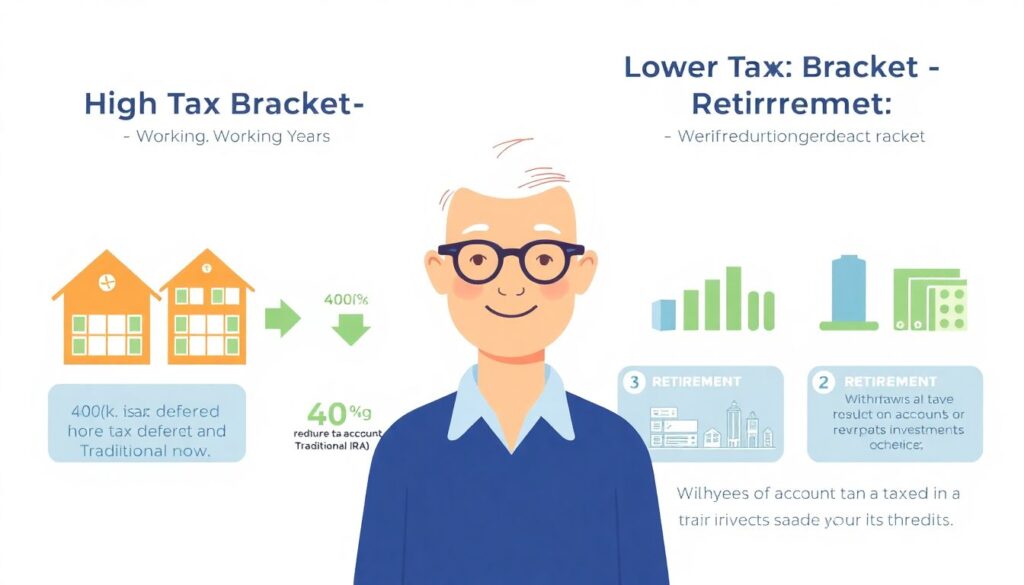
The accounts you use can be as important as the investments themselves, because taxes directly reduce the cash you keep. If you’re in a high tax bracket in your 50s and expect a lower bracket after you stop working, traditional tax‑deferred accounts (401(k), traditional IRA) often make sense: you get a current deduction, and withdrawals are taxed later. If you expect similar or higher taxes later, Roth options become more attractive. In practice, many 50‑somethings benefit from a mix: maxing a traditional 401(k) to reduce current taxes and also funding a Roth IRA (or using Roth 401(k) features) to create tax‑free income sources later. Coordination allows more control over your taxable income in retirement, which affects not only taxes but also healthcare subsidies and pension phase‑outs.
Your “product choice” is secondary; the tax wrapper is a structural decision.
Technical snapshot: Simple tax‑optimization hierarchy (U.S. bias)
A commonly used order of operations (adapt to your country):
1. Capture full employer match in 401(k)/similar (100% instant return).
2. Max HSA (if available and you can treat it as long‑term medical savings).
3. Fund IRA (traditional or Roth depending on tax situation).
4. Increase 401(k) up to annual and catch‑up limits.
5. Invest in taxable brokerage, using tax‑efficient index funds and ETFs.
Over 50, re‑evaluate this hierarchy annually. Changes in income, bonuses, or nearing retirement can flip whether pre‑tax or Roth contributions are more efficient.
—
Step 6. Manage debt and housing as strategic levers
Don’t ignore the mortgage – but don’t obsess either
For many 50‑somethings, the biggest non‑human asset and liability are the house and its mortgage. The question “Should I pay off my mortgage before retirement?” has no universal answer. The key variables are interest rate, cash flow, risk tolerance, and psychological comfort. If your mortgage rate is significantly below expected long‑term investment returns (say 3% vs a 5–7% expected portfolio return), aggressively prepaying may not be mathematically optimal. But if eliminating a $1,800 monthly payment dramatically lowers your required retirement income and gives you peace of mind, directing part of your excess cash flow to early payoff can improve your overall risk profile. A client couple, both 53, targeted a hybrid: extra payments to ensure payoff by 65, while still maxing retirement accounts. That compromise balanced math with emotion.
The correct decision is the one that keeps your plan resilient and you calm during volatility.
Technical snapshot: Debt‑to‑income and housing metrics
Useful thresholds as you approach retirement:
– Total debt‑to‑gross‑income: Aim to be under 1.0 by your early 60s (e.g., $400k debt on $400k household income).
– Housing costs (PITI + HOA) to gross income: Try to keep below 25% going into retirement.
– Remaining mortgage term: Ideally, schedule payoff no later than 5 years into retirement, unless the rate is extremely low and you have ample liquid assets.
If ratios are higher, consider downsizing, refinancing, or more aggressive debt repayment as part of your retirement planning in your 50s.
—
Step 7. Protect against the big retirement “wild cards”
Healthcare, longevity, and sequence risk
Investment returns are not the only threats to a financially stable retirement. The three big wild cards are healthcare costs, living longer than expected, and poor market returns early in retirement (sequence risk). You cannot control these, but you can hedge them. Confirm coverage paths from 60 to your country’s public healthcare age; in the U.S., for example, retiring at 62 means bridging three years to Medicare, often at high private insurance premiums. Consider long‑term care risk: you may choose insurance, dedicated savings, or home‑equity as your funding source. Longevity risk can be partially mitigated with guaranteed income: Social Security optimization, defined‑benefit pensions, or annuities. None of these products are magic, but they shift specific risks away from your portfolio, making it easier to maintain your withdrawal plan.
Planning for “what if I live to 95?” is an act of caution, not pessimism.
Technical snapshot: Handling sequence‑of‑returns risk
To reduce the danger of bad returns in your first retirement years:
– Hold at least 3–5 years of planned withdrawals in low‑volatility assets by your retirement date.
– Use a flexible withdrawal policy: e.g., temporarily reduce withdrawals after a large market drop instead of rigidly sticking to a fixed real amount.
– Avoid big portfolio changes in the middle of a bear market; pre‑set rebalancing rules help.
– Consider partial annuitization to cover non‑discretionary expenses, so market crashes mostly affect discretionary spending.
Back‑tests show that flexible withdrawals with guardrails significantly improve portfolio survival odds versus rigid 4% withdrawals, especially for retirees with higher equity exposure.
—
Step 8. Use professional help wisely – and know what to ask
When a financial advisor actually adds value
In your 50s, your finances are complex enough that a specialist can meaningfully improve outcomes – if you choose wisely. A competent financial advisor for retirement planning in your 50s should help with tax‑efficient withdrawal planning, Social Security or pension timing, investment policy design, insurance analysis, and behavioral coaching during crises. The value isn’t only in picking funds; it’s in building and *maintaining* a coherent plan. When markets fell in 2020, one of my clients, 57 at the time, wanted to move everything to cash. We walked through his bucket strategy, stress tests, and funding ratio. Seeing that his plan withstood repeated 30–40% market drops convinced him to stay the course. By late 2021, his balance was significantly higher than it would have been had he sold. That’s real value.
If a prospective advisor can’t explain their process and compensation clearly, keep looking.
Technical snapshot: Due‑diligence checklist for advisors
Ask specific, technical questions:
– Are you a fiduciary at all times? How are you compensated (fee‑only, fee‑based, commission)?
– What is your typical client profile, and what percentage are in their 50s or retired?
– How do you build retirement investment strategies for people in their 50s – what is your framework?
– How do you integrate tax planning, withdrawal sequencing, and Social Security/pension decisions?
– How often will we review the plan and under what triggers will you recommend changes?
Document the answers. An advisor who talks only about performance and products, not about process and risk management, is a salesperson, not a planner.
—
Step 9. Turn your plan into an annual routine
From “one‑time fix” to ongoing system
Retirement planning is not a document you create once and file away; it’s a living system that must adapt to markets, health, family, and career changes. In practice, a lean annual routine is enough for most people in their 50s. Once a year, update your retirement balance sheet, recalc your funding ratio, and check if your savings rate still fits your target retirement age. If markets had an extreme year, rebalance back to your target allocation. When a life event happens – job loss, inheritance, divorce, illness – pause and redo your projections. A 53‑year‑old client who received a modest inheritance used it not to upgrade his car, but to fully fund a Roth IRA ladder and pay down high‑rate debt, shaving three years off his planned retirement date.
Consistency beats brilliance. A good, simple process done every year outperforms a perfect plan done once.
Technical snapshot: Minimal annual review agenda
Once a year, ideally same month:
1. Update all account balances and debts; recompute net worth and retirement‑specific funding ratio.
2. Compare actual savings to target (e.g., did you hit 20% of gross income?).
3. Rebalance portfolios if any asset class is more than 5 percentage points off target.
4. Re‑run a simple projection: expected portfolio at retirement given current savings and return assumptions.
5. Check for tax‑planning opportunities: Roth conversions, tax‑loss harvesting, or shifting account types.
Document decisions and assumptions. Next year, you’ll see progress – or catch drift – early enough to correct course.
—
Bringing it all together in your 50s
Your 50s are not about perfection; they are about compression. You have fewer years to save and fewer chances to recover from big mistakes, but also higher income, clearer priorities, and access to powerful catch‑up tools. Focus on the essentials: translate your desired lifestyle into numbers, measure your gap honestly, use catch‑up contributions aggressively, design a risk‑appropriate investment strategy, manage debt and housing with intention, and hedge the big unknowns like health and longevity. Then, either on your own or with a skilled advisor, revisit the plan every year.
A financially stable retirement isn’t reserved for those who started perfectly at 25. It’s available to those in their 50s who are willing to confront reality, use the tools available, and make a series of deliberate, technically sound decisions from now until the day they decide work becomes optional.