
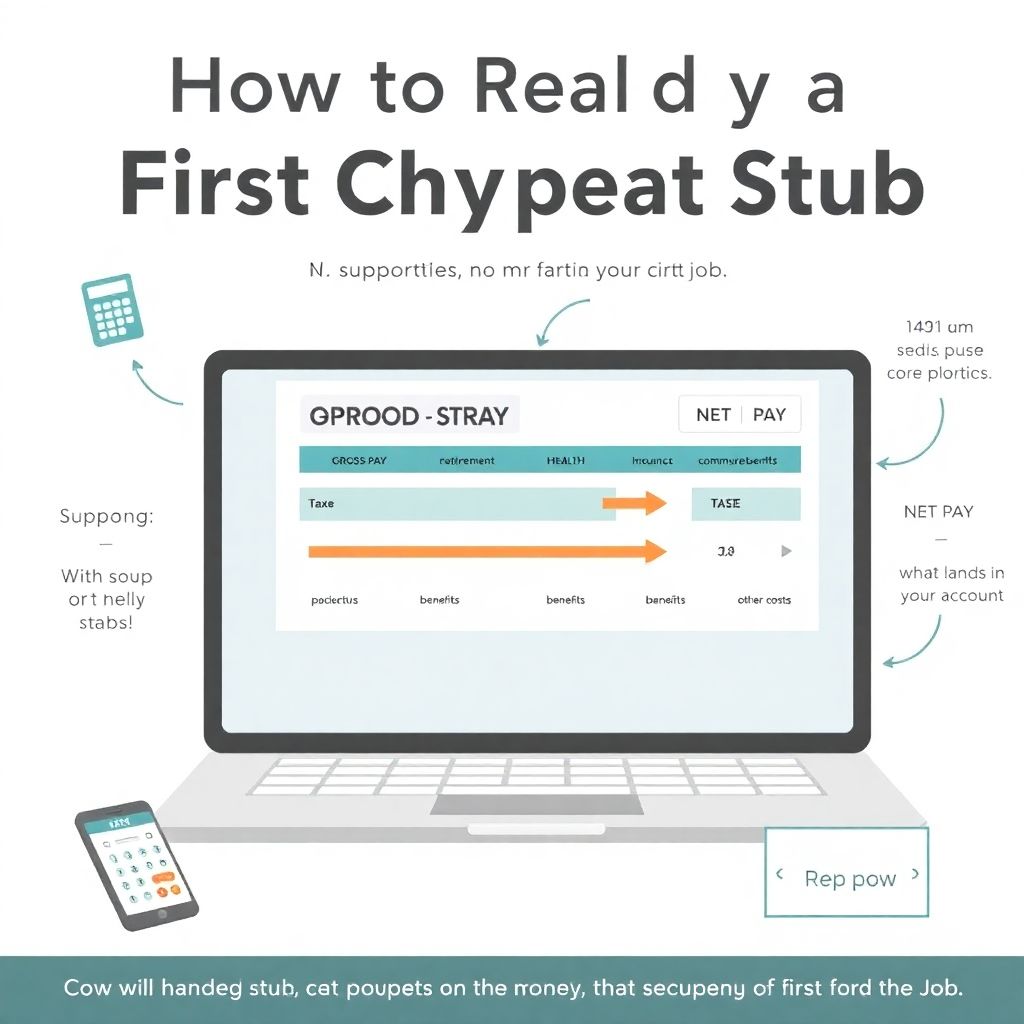
Step 1: Don’t Just Stare at the Number — Break the Paycheck into Pieces
When you see your first paycheck, the instinct is to zoom in on the “Net Pay” line and wonder what went wrong. Before you panic, slow down. Your paycheck is basically a layered receipt: gross pay, pre‑tax stuff, taxes, post‑tax stuff, and what’s left for you.
A simple way to start learning how to read your first paycheck stub is to treat it like a puzzle with five main pieces:
1. What you actually earned (Gross Pay)
2. What came out before taxes (Pre‑tax deductions)
3. The taxes themselves
4. What came out after taxes (Post‑tax deductions)
5. What finally lands in your account (Net Pay)
If you understand each of these blocks, everything else is just details and acronyms.
—
Step 2: Decode Gross Pay — Your “Theoretical” Income
Gross pay is your “perfect world” number: what your employer would pay you if there were no taxes and no deductions at all. It’s usually:
– Hourly rate × hours worked, or
– Annual salary ÷ number of pay periods (e.g., 26 if biweekly).
If you’re salaried and your gross pay looks suspiciously low or high, back‑calculate it:
Annual salary ÷ number of paychecks per year. If that doesn’t match what’s on the stub, something’s off and you should ask HR or payroll to explain.
Short warning:
If you’re getting overtime, bonuses, or commissions, those may show up as separate earnings lines. Don’t ignore them — some employers tax bonuses at a different withholding rate, which can make them look “over‑taxed” compared to your base pay.
—
Step 3: Meet the “Invisible Helpers” — Pre‑Tax Deductions
Before a single tax is calculated, some items may be subtracted from your gross pay. These are pre‑tax deductions: retirement contributions (like 401(k)), certain health insurance premiums, commuter benefits, or health savings account (HSA) contributions.
These pre‑tax items shrink the income number that your taxes are based on. That’s not just nice — it’s strategic.
Here’s the twist most beginners miss:
If you’re asking yourself how to reduce taxes taken out of my paycheck without doing anything sketchy, pre‑tax deductions are the cleanest, legal way to do exactly that. You’re not dodging tax; you’re lowering the amount that’s taxed in the first place.
—
Step 4: Understand the Tax Pile — Federal, State, and the Two “Mystery” Ones
This is where people start muttering why are so many taxes taken out of my paycheck. The answer is that “taxes” on your stub are actually several different charges stacked together, and they don’t all work the same way.
You’ll usually see:
1. Federal income tax – based on your taxable income and the info you gave on your W‑4.
2. State income tax (and sometimes city/local) – depends on where you live and/or work.
3. Social Security tax – a flat 6.2% on wages up to an annual limit (your employer pays another 6.2% on top, but that part doesn’t appear on your stub).
4. Medicare tax – a flat 1.45% on all wages (again, your employer matches). Higher earners may have an extra 0.9%, but that’s not common for a first job.
Short version: your paycheck has a “federal team,” a “state team,” and the Social Security/Medicare duo quietly taking their cut every pay period.
—
Step 5: Attack It Like an Analyst — Check the Math with Tools
Instead of guessing whether your paycheck is “right,” run it through an external lens. That’s where a paycheck tax calculator for first job can be really useful. You plug in:
– Gross pay for the period
– Pay frequency
– Filing status and number of dependents
– State
– Any pre‑tax deductions
Then compare the result to your stub. If the numbers are in the same ballpark, you’re probably fine. If the gap is huge, that’s your cue to ask payroll questions instead of silently fuming for six months.
Tip: Use calculators from neutral or well‑known sources (major tax software sites, big payroll companies, or nonprofit financial education orgs). Avoid random sites that look like they were coded in 2003 and last updated never.
—
Step 6: W‑4 Reality Check — The Form That Quietly Controls Your Take‑Home Pay
Your W‑4 tells your employer how much federal income tax to withhold. If you don’t understand it, your paycheck might be wrong for your actual situation, even if the math is technically “correct.”
If you claimed too little withholding, you’ll enjoy bigger paychecks now and a nasty tax bill later. If you claimed too much, you’ll get smaller paychecks now and a refund later — which is basically giving the government an interest‑free loan.
A surprisingly effective habit: once you’ve seen 1–2 paychecks, go back and reread your W‑4. Plug your situation into a calculator and see if the current withholding lines up with your goals:
– Want a bigger refund? Withhold more.
– Want more cash now and don’t mind settling up later? Withhold less (but stay within safe harbor rules).
—
Step 7: The “Why Is My Net Pay So Tiny?” Breakdown

If you’re thinking, “My offer letter number was huge, my actual paycheck is not – what happened?”, do a structured breakdown instead of panicking.
Try this exercise once, on paper or a note app:
1. Write your gross pay for the period.
2. Subtract pre‑tax deductions.
3. From the result, subtract each tax line item.
4. Then subtract post‑tax deductions.
5. Circle what’s left: net pay.
That’s understanding paycheck deductions and taxes in the most concrete way possible: as a series of filters. Viewing it visually like this tends to calm people down because the “mystery” disappears.
—
Step 8: Common Rookie Mistakes (and How to Avoid Them)
Long list, short lessons:
1. Ignoring pay frequency
Seeing “$50,000 per year” and expecting your biweekly paycheck to be anywhere near $50,000 ÷ 12.
Always divide by the actual pay periods (often 26, sometimes 24 or 52) before comparing expectations to reality.
2. Thinking taxes = just “federal”
Many people only think about federal income tax and forget state, Social Security, and Medicare. When all four show up, they’re shocked.
Mentally expect four main tax lines; anything extra is a bonus, not a headline.
3. Not noticing pre‑tax vs post‑tax deductions
Treating a 401(k) deduction as “money lost” instead of “money saved plus tax reduced.”
Label your deductions in your head as either “helps me now and later” (pre‑tax retirement, HSA) or “just necessary cost” (some post‑tax benefits).
4. Never updating the W‑4 after life changes
New job, second job, moving states, or big pay raise? Withholding should be reviewed.
Mark “check W‑4” as a to‑do every time something big changes in your life or income.
5. Using only last year’s refund as a guide
The tax system, your income, and your life all change.
A decent approach is to use last year as a reference, not a blueprint, and adjust with fresh numbers.
—
Step 9: Non-Obvious Ways to Tweak Your Take‑Home (Legally)
Beyond the usual “fill out W‑4 correctly” advice, there are some unconventional but fully legal strategies:
1. Stack pre‑tax events in the same year
If your job offers a 401(k) match, HSA, and commuter benefits, use them together instead of picking just one. Each extra pre‑tax dollar chips away at current taxable income.
You’re building a mini tax‑shelter ecosystem inside your paycheck.
2. Use timing to your advantage
If you can choose when a bonus is paid (late December vs early January), realize it can:
– Land in a different tax year, and
– Potentially keep you in a lower bracket for the current year.
This won’t always be possible, but it’s worth asking if your manager or HR has flexibility.
3. Treat side gigs as tax balancing tools, not just extra money
Side income gives you access to deductions (equipment, home office portion, mileage) if you run it as a legit business.
You may pay self‑employment tax, yes, but you also control the timing of some expenses and estimated payments — which means you’re less at the mercy of single‑employer withholding.
4. Intentionally aim for “boringly accurate” withholding
Most people emotionally aim for either “massive refund” or “max paycheck.” A more analytic approach: aim for no drama.
Adjust your W‑4 until tax calculators show you roughly breaking even at year‑end. It’s not glamorous, but it’s efficient.
—
Step 10: Using Calculators Like an Analyst, Not a Fortune Teller
Many people type their numbers into a paycheck calculator, see something slightly different from their stub, and assume someone made a mistake. Calculators are models, not oracles. They use assumptions: no mid‑year changes, no odd fringe benefits, no rare local taxes, etc.
The smart way to use them:
– Run your actual paycheck numbers through a tool once.
– If the gap is minor, treat it as rounding and assumptions.
– If the gap is big, isolate where: is it federal, state, Social Security, or some deduction the calculator didn’t know about?
When you’re exploring how to read your first paycheck stub, combining your actual stub with a calculator output is like double‑entry bookkeeping for your own sanity.
—
Step 11: Experimental Tweaks — Safely “A/B Test” Your Paycheck
You can test changes the way product teams test features.
1. Pick one variable at a time
Adjust your W‑4, or increase your 401(k) rate, or change your commuter benefit — but not all three at once.
This way, when your next paycheck arrives, you know exactly what caused the shift.
2. Snapshot before and after
Take a screenshot or photo of your paycheck stub lines *before* the change.
Compare line by line to the *after* stub. Which taxes went down? Did any go up? Did any benefits change base amounts?
3. Evaluate over at least two pay periods
Occasional weirdness happens — odd hours, one‑time bonuses, or system corrections.
Judge the effect of a change only after seeing it for two “normal” cycles.
This method turns your first job into a controlled experiment in personal finance instead of a long guessing game.
—
Step 12: Why Your Friend’s Paycheck Looks Different (Even with the Same Salary)
It’s tempting to compare. Same job title, same company, same base pay — but your coworker’s net pay isn’t matching yours. That doesn’t automatically mean something’s wrong.
Differences often come from:
– Different W‑4 choices
– Different states or cities (remote work can complicate this)
– Different pre‑tax benefits (one uses 401(k) heavily, the other doesn’t)
– Different post‑tax deductions (union dues, extra insurance, garnishments)
Instead of trying to copy someone else’s numbers, reverse the question:
“Given my life and goals, what should *my* paycheck look like?”
This is more productive and keeps you out of a spiral of unfair comparisons.
—
Step 13: When to Ask for Help (and What Exactly to Ask)

You don’t have to turn into a tax pro to handle your first paycheck, but you should recognize when something looks off enough to justify asking questions.
Look out for:
– A sudden unexplained drop in net pay without a corresponding change in hours or benefits
– Taxes that look wildly higher than a reputable calculator suggests
– Deductions you don’t recognize or that appear under vague labels
When you contact HR or payroll, be precise:
– Mention the pay period, line item, and what you expected versus what you see.
– Ask, “Can you walk me through how this number is calculated?” rather than “Why is this so high?”
This keeps the conversation factual and makes it easier for them to help you correct real errors.
—
Step 14: Building a Simple “Paycheck System” for Yourself
The real win isn’t just understanding one paycheck; it’s setting up a repeatable system so taxes stop being mysterious background noise.
A minimal but effective system:
1. First paycheck at any new job
– Read every line.
– Run it through a calculator.
– Adjust W‑4 if needed.
2. Every January or after a big change
– Rerun the numbers based on your expected income for the year.
– Revisit pre‑tax options (401(k), HSA, commuter benefits).
– Decide consciously how much current cash vs future benefit you want.
3. Mid‑year checkup
– Estimate total income so far.
– See if withholding still seems on track.
– Nudge W‑4 if you’re drifting off course.
In other words, you’re not just reacting to whatever lands in your bank account — you’re quietly steering the ship.
—
Final Thought: Turn Confusion into a Habit of Curiosity
Your first paycheck is confusing on purpose: the tax system wasn’t designed to be friendly or intuitive. But once you walk through each layer — gross, pre‑tax, taxes, post‑tax, net — the whole thing stops feeling like a black box.
Understanding paycheck deductions and taxes isn’t about memorizing every rule; it’s about having a method:
– Read the stub analytically
– Cross‑check with tools
– Adjust one lever at a time
– Use pre‑tax options as your built‑in “tax strategy”
– Ask focused questions when something looks wrong
Do that, and you’re not just surviving your first job — you’re quietly building the skill set that makes every future paycheck, raise, and bonus work harder for you.