
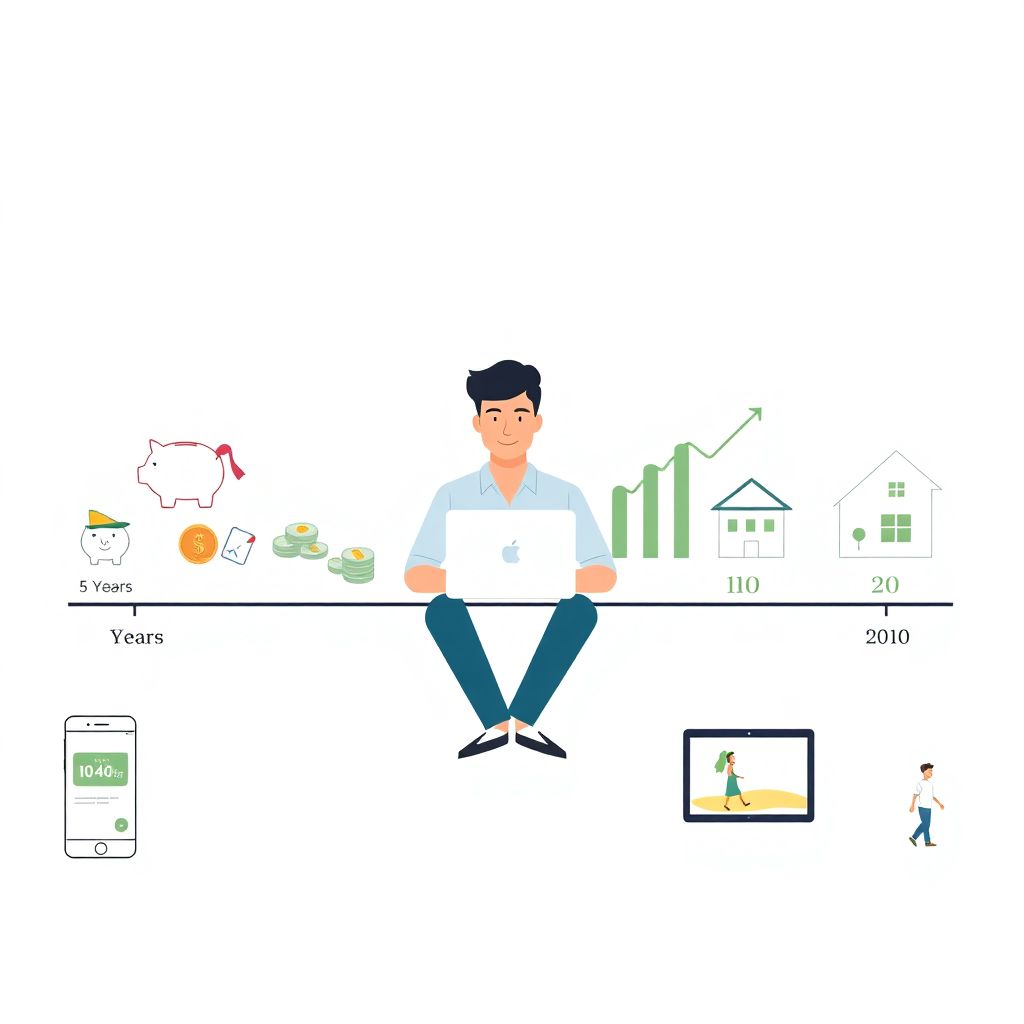
Why a 5, 10, and 20‑Year Plan Is More Useful Than One Big “Lifetime Plan”
Thinking in clean 5, 10, и 20‑year chunks is a lot more practical than dreaming about “financial freedom someday.” A 5‑year plan usually deals with stability and flexibility: building an emergency fund, killing high‑interest debt, maybe saving for a home or a career pivot. The 10‑year horizon is where medium‑sized moves live: funding kids’ education, scaling investments, or planning a big lifestyle upgrade. The 20‑year view is almost always about retirement and investment planning 10 20 years ahead, even if you’re young and retirement feels far away. Breaking things into these windows lets you adjust your strategy as life happens, instead of trying to nail a single perfect forecast that will obviously be wrong in a decade.
At the same time, these horizons must connect. Your 5‑year decisions set the foundation that either powers up or sabotages what’s possible in 10 and 20 years. Aggressively buying an expensive house now, for example, may crowd out your ability to invest enough later to retire comfortably. Conversely, delaying any lifestyle inflation for the first 5 years after a big income jump can massively increase your investment base by year 10. The idea isn’t to obsessively predict every dollar, but to set clear targets for each time frame, pick a simple path to reach them, and build a habit of revisiting the plan at least once a year so your choices stay aligned with your actual life, not an old spreadsheet fantasy.
Step 1: Turn Vague Wishes into Real Numbers
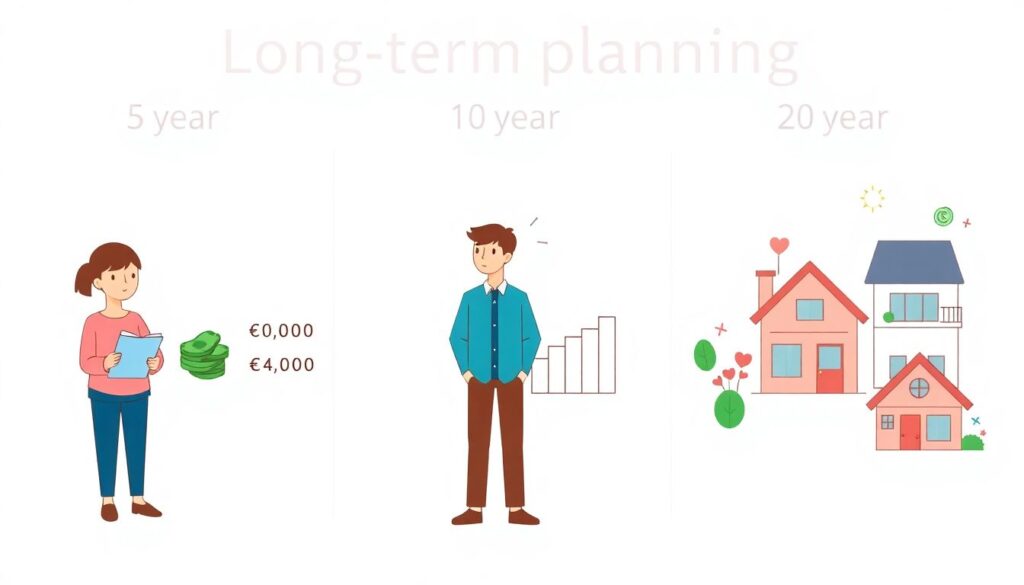
Before choosing tools or services, get specific. A simple way is to write one or two “headline goals” for 5, 10, and 20 years, then attach real numbers. For 5 years, that might be “€20,000 emergency fund, zero high‑interest debt, and €40,000 invested.” For 10 years, it might be “mortgage down payment of €80,000 and investment portfolio of €120,000.” For 20 years, you might aim for “investment portfolio of €600,000 generating partial financial independence.” These don’t have to be perfect; the goal is to give yourself a measuring stick. From there you can estimate how much you must save monthly, assuming a conservative average return. There are plenty of online calculators that will do this for you in seconds.
This is where financial planning services for 5 10 20 year goals start to show their value. A professional or a good tool can help you translate a messy collection of desires—travel more, buy a house, support aging parents—into a timeline and a cash‑flow plan. If you prefer to stay fully DIY, you can still borrow their logic: define the outcome, put a number on it, assign a deadline, and reverse‑engineer the monthly savings. It’s less about predicting the future and more about setting a direction. You will absolutely revise these numbers as your income, family situation, and priorities change, but without initial targets it’s impossible to say whether you’re actually on track or merely hoping things work out.
Step 2: Build a 5‑Year Plan That Survives Real Life
For the next five years, resilience matters more than optimization. The core pieces are straightforward: a cash buffer, controlled spending, and consistent investing. Start with an emergency fund covering at least three to six months of essential expenses, kept in a simple savings account or money market fund. This is not about chasing yield; it’s about not being forced to sell investments at a bad time when the car dies or you lose your job. At the same time, attack any high‑interest debts, especially credit cards or payday loans, because their interest is almost always higher than what you can earn reliably in the market.
Once those basics are covered, automate investments every time you get paid. For many people, the simplest setup is a low‑cost index fund or ETF in a retirement or brokerage account. At this stage, technology can genuinely reduce friction: the best financial planning software for long term goals often includes budgeting, automated transfers, and goal‑based investment dashboards that show you whether your monthly contributions are enough. The trade‑off is that some apps nudge you toward specific financial products or charge opaque fees. Look for tools that are transparent about costs, let you export your data, and don’t lock you into a single provider. You want your 5‑year system to be easy to maintain even if you change banks or investment platforms.
Step 3: Shape a 10‑Year Plan Around Lifestyle and Growth
Ten years is long enough that compounding really starts to matter, but still close enough that your assumptions must stay conservative. Here you think about bigger shifts: buying property, starting or scaling a business, planning for children, or even retraining for a different career. The key is to map how those life moves interact with your finances. If you expect childcare costs to spike in three years, you can deliberately increase your cash savings now and plan to slow investment contributions during those expensive years, then ramp them back up later instead of feeling like you “failed” your plan.
This is also the phase where many people first consider talking to a professional. When you search something like “long term financial planner near me,” what you’re really asking is, “Who can help me avoid big mistakes as my finances get more complex?” The pros here include structured guidance, tax‑efficient strategies, and a neutral third party who can stress‑test your ideas. The cons are cost and quality variation: some advisers are excellent fiduciaries, others are salespeople with quotas. If you decide to hire a certified financial planner for long term plan design, check their credentials, how they’re paid (fee‑only vs. commission), and whether they act as a fiduciary obligated to put your interests first. A well‑chosen planner can be worth far more than their fee if they help you avoid just one or two major errors over a decade.
Step 4: 20‑Year Planning Without Overcomplicating It
Twenty years feels like another lifetime, which tempts people either to ignore it entirely or to create hyper‑detailed projections that break down in year three. A better approach is to focus on direction and capacity rather than precision. For example, you might set a target to be mortgage‑free and have investments capable of covering at least 50–70% of your current lifestyle costs in 20 years, then reassess that target every couple of years as your income, health, and family situation evolve. You can run rough scenarios based on different market returns, inflation rates, and savings levels, not to pin down a single number, but to understand which levers move the outcome the most.
Technology can help with this “what if” analysis. Many modern tools let you simulate different retirement ages, savings rates, and market conditions. However, one of the underrated risks of using advanced software is false confidence: slick charts can make the future look more predictable than it is. That’s why even the best financial planning software for long term goals should be treated as a testing ground, not an oracle. On the human side, a planner with experience in retirement and investment planning 10 20 years out can help you simplify decisions: how aggressively to invest, which tax‑advantaged accounts to prioritize, and when to de‑risk. The real win is not a perfect 20‑year roadmap, but a habit of adapting your plan while keeping your long‑term direction intact.
Comparing DIY, Hybrid, and Full‑Service Planning
There are three broad approaches: fully DIY, hybrid (software plus occasional professional input), and full‑service planning. DIY is attractive if you enjoy learning about money and want tight control over fees. You can use free calculators, broker tools, and budget apps to build a simple system that covers your 5, 10, and 20‑year goals. The downside is time and emotional bandwidth: in a crisis or during major life changes, it’s easy to freeze, second‑guess, or follow the latest online advice that doesn’t fit your situation. DIY works best if you’re willing to schedule regular “money days” to review everything and if your financial life is still relatively straightforward.
Hybrid planning combines apps with targeted expert help. You might run your day‑to‑day budget and investments yourself while booking a check‑in with a planner every year or two, especially when facing big decisions like buying a home, changing careers, or exercising stock options. This setup often delivers a solid balance: low ongoing costs, but access to expertise when it matters most. Full‑service planning, where a professional actively manages most aspects of your finances, offers the most hand‑holding and can be invaluable for people with complex assets or very limited time. However, it’s the most expensive option and can tempt you to disengage completely from your own money. When comparing these approaches, think less about what is theoretically “optimal” and more about what you’ll consistently stick with for the next 20 years.
Tech Tools: Pros, Cons, and How to Choose
Modern tools make it possible to build a robust plan with just a laptop and a bank account, but each category has trade‑offs. Budgeting apps and cash‑flow trackers are excellent at showing where your money goes and enforcing your 5‑year targets. Their main downside is that they often nudge you toward short‑term optimization—cutting coffee, chasing cashback—while your biggest gains come from big decisions like housing, career, and investing strategy. Investment platforms and robo‑advisors simplify portfolio management and automatic rebalancing, which is especially useful when you’re dealing with multiple 10‑year goals at once. The drawback is that some of them hide higher fees inside “convenience,” which silently erodes long‑term returns.
More advanced planning tools try to integrate everything: net worth tracking, goal‑based projections, tax‑aware investing, and even estate planning. Used well, they can act as your personal control panel for the 20‑year horizon. But they also require discipline: messy inputs produce misleading outputs, and over‑tweaking assumptions can trick you into obsessive tinkering instead of focusing on the simple behaviors that really drive success—saving enough and investing consistently. When evaluating technology, ask three questions: Does this help me see my 5, 10, and 20‑year picture more clearly? Does it actually change my behavior in a good way? And are the costs and data‑sharing trade‑offs worth it? If the answer is not a clear yes, you’re probably better off with simpler tools you actually use.
When It Makes Sense to Bring in a Professional

There are certain life moments when outside help can save you from expensive mistakes: receiving an inheritance, getting stock options, going through a divorce, selling a business, or approaching retirement with multiple account types and obligations. In these situations, searching for a long term financial planner near me is not about outsourcing your entire life, but about getting a second pair of trained eyes on decisions that are hard to unwind later. A good planner will start by understanding your goals over 5, 10, and 20 years rather than jumping straight into products or investments. They should explain their recommendations in plain language and show exactly how they’re paid.
Not all “advisors” are equal. Some are heavily product‑driven, compensated mainly by commissions on what they sell you. Others operate on a transparent fee‑only model. If you choose to hire a certified financial planner for long term plan design, you’re at least working with someone who has met a recognized standard of education and ethics. Still, you need to interview them: ask how they work with clients over multiple decades, how they handle market downturns, and how they coordinate with tax and legal professionals. The ideal relationship feels like having a knowledgeable guide, not a boss or a salesperson. You should leave meetings understanding not just what to do, but why it fits your 5, 10, and 20‑year roadmap.
Trends Shaping Financial Planning in 2025
In 2025, a few big trends are changing how people build simple long‑term plans. First, personalization driven by data is moving from marketing talk to actual practice. Many platforms now analyze your spending, savings patterns, and risk tolerance to suggest tailored paths for different time horizons, from your 5‑year safety net to your 20‑year retirement payoff. The upside is faster, more relevant recommendations; the downside is deeper data collection and potential bias in what’s recommended. Second, low‑cost investing has gone mainstream, which means you no longer have to accept high fees just to access diversified portfolios. This is good news for 10 and 20‑year investors, since even tiny fee differences compound meaningfully over decades.
Another trend is the blending of human and digital advice. Instead of choosing between a pure robo‑advisor and a traditional planner, more people are using hybrid financial planning services for 5 10 20 year goals, where software handles routine tasks and humans step in for complex decisions. There’s also a growing awareness that money planning must account for mental health, career shifts, and even climate or geopolitical risks; in other words, long‑term plans must be robust to disruption, not just optimized for a stable world. Finally, regulation is slowly pushing the industry toward greater transparency, particularly around fees and conflicts of interest. For you, this means more power to compare options and insist on clear explanations of how a product or service helps you over each time horizon.
Putting It All Together: A Simple, Actionable Framework
If you want a practical way to start today, think in layers. For the next 5 years, focus on stability: build your emergency fund, clear bad debt, and automate a starter level of investing. Accept that this phase may feel slow and unglamorous, but it creates the base that makes everything else easier. Over the 10‑year span, link your money to your lifestyle: plan for housing, family, career changes, and big projects, and adjust your saving and investing to match those timelines. Revisit your assumptions at least annually, and after any big life event. For the 20‑year horizon, keep things high‑level but concrete enough to guide decisions: how independent do you want to be, and by when; what kind of work do you want to be doing, if any; and what level of risk are you truly comfortable living with.
As your situation grows more complex, don’t hesitate to upgrade your toolkit. That might mean moving from a simple spreadsheet to more capable software, or from pure DIY to a hybrid model with occasional professional input. It might mean shifting from accumulation to preservation as you get closer to your 20‑year goals, or integrating more detailed tax and estate planning. Whatever you choose, the real power lies in consistency: checking in on your plan, updating it as life changes, and staying invested through market noise. A simple plan you actually follow for 5, 10, and 20 years will beat a perfect plan you abandon within months.