
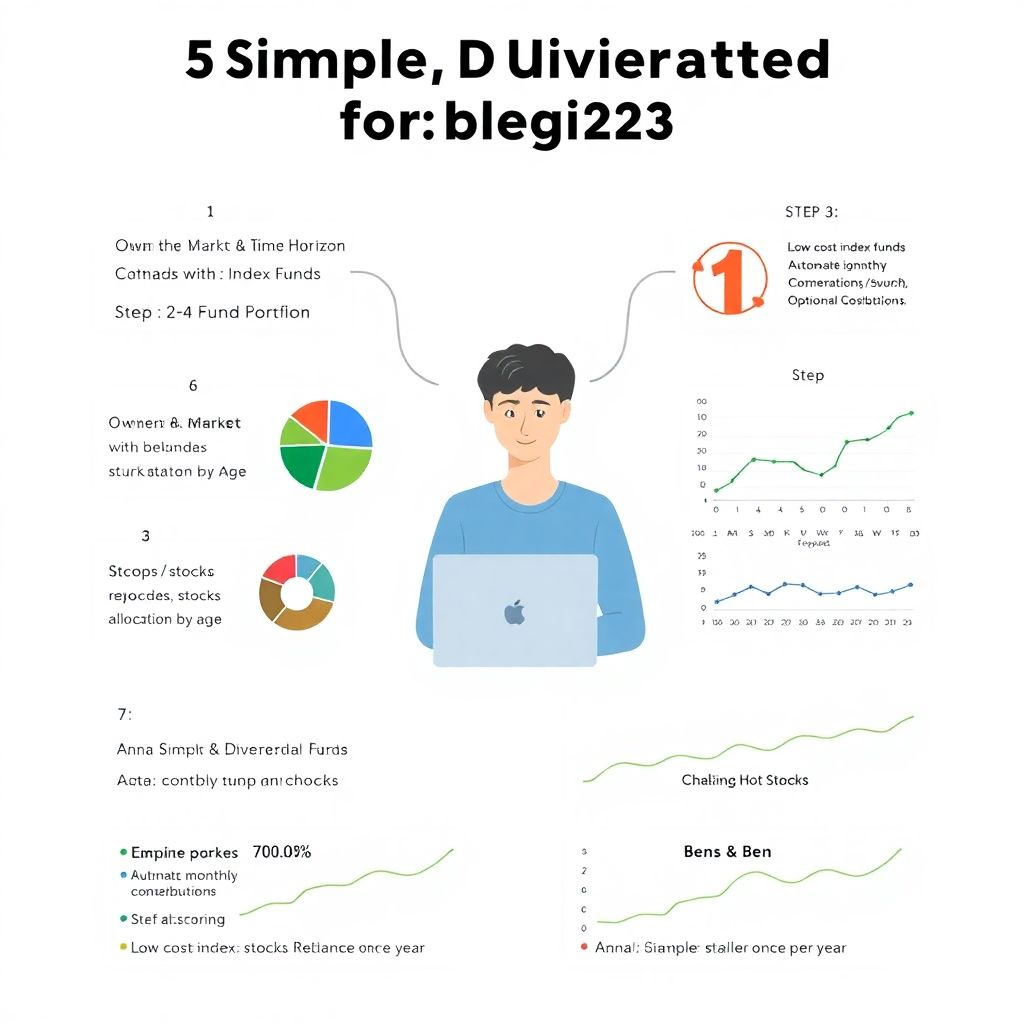
Why a Simple, Diversified Portfolio Beats “Smart” Stock Picks
Most beginners start by asking: “What’s the best investment portfolio for beginners that actually works and doesn’t take tons of time?”
Not “How do I beat Wall Street?”
Not “Which stock will 10x next year?”
The honest answer from both academic research and real‑world practice:
A simple, diversified investment portfolio built with low-cost index funds usually beats most active investors over 10–20 years, especially after fees and taxes.
In 2025, with zero‑commission brokers, fractional shares, and robo‑advisors, the real edge is no longer “access.” It’s behavior and simplicity.
Step 1. Decide What This Portfolio Is For
Your portfolio’s structure depends on its job. A 24‑year‑old saving for retirement in 40 years and a 45‑year‑old saving for a home in 5 years do not need the same setup.
Clarify three numbers
1. Time horizon
Ask: *“When will I start using this money?”*
– Less than 3 years → this should mostly stay in cash / high‑yield savings, not in stocks.
– 3–10 years → mixed approach, more bonds and cash.
– 10+ years → more stocks are usually reasonable.
2. Risk tolerance
Forget the cute quizzes for a moment.
Imagine a 30% drop in your investments.
– If that would make you sell everything in panic → you need more bonds and cash.
– If you’d be annoyed but could keep buying → you can handle more stocks.
3. Contribution ability
Ask: *“How to start investing with a small amount of money without overcomplicating it?”*
If you’re starting with $50–$100 per month, you still can build a serious long‑term portfolio, but you must keep it:
– Cheap
– Automated
– Diversified with just a few funds
Step 2. The Core Idea: Own the Market, Don’t Predict It
Why index funds are the backbone
A stock index fund simply buys all (or most) of the stocks in a market index (like the S&P 500).
A bond index fund does the same for bonds.
Over long periods:
– Around 80–90% of actively managed funds fail to beat their benchmark after fees.
– Costs are a guaranteed drag; outperformance is not.
That’s why when people talk about simple investment strategies for beginners, they usually mean:
– Own broad stock index funds
– Own broad bond index funds
– Rebalance once a year
– Don’t touch it otherwise
In practice, the best investment portfolio for beginners is usually a boring mix of:
– A global or U.S. stock index fund
– A high‑quality bond index fund
– Maybe a small slice of real estate or international stocks
Nothing fancy. Just disciplined.
Step 3. Choosing Your Building Blocks (Without Getting Lost)

Let’s break down how to build a diversified investment portfolio using 2–4 funds you can actually remember.
Core fund types
1. Broad U.S. stock market fund
– Goal: Own most of the U.S. stock market in one shot.
– Typical examples: Funds tracking the Total U.S. Stock Market or the S&P 500.
– Why: Historically, U.S. stocks returned ~9–10% per year before inflation over long periods (individual years vary a lot).
2. International stock market fund
– Goal: Own developed and emerging markets outside the U.S.
– Reason: The U.S. will not always be the best performer; you want diversification across regions.
– Typical long‑term weight: 20–40% of your stock allocation.
3. Bond index fund
– Goal: Stabilize your portfolio and reduce drawdowns.
– Focus: High‑quality government and investment‑grade corporate bonds.
– Expectation: Lower return than stocks, but much smaller downturns.
4. Optional: Real Estate (REIT) fund
– Goal: Add exposure to real estate without buying a physical property.
– Caveat: REITs can be volatile like stocks, so treat them as part of your stock allocation, not a safe asset.
Technical block: What “low-cost” actually means
> Technical details: Fees & cost thresholds
>
> – Expense ratio under 0.20% is generally considered low. Many major index funds are 0.03–0.10%.
> – A 1.0% annual fee may sound small, but over 30 years it can eat 20–25%+ of your final wealth compared to a 0.1% index fund, assuming the same gross performance.
> – Prefer broad, cap‑weighted index funds (e.g., total market, S&P 500, global ex‑US) over super‑narrow niche funds.
Step 4. Basic Allocation Models by Age and Risk
There is no magic formula, but some rules of thumb are useful starting points.
Age‑based stock/bond split
A classic guideline:
Stocks = 100 – your age (adjusted for your risk tolerance).
So at:
– 25 years → 75–90% stocks, 10–25% bonds
– 40 years → 60–80% stocks, 20–40% bonds
– 55 years → 40–60% stocks, 40–60% bonds
If volatility really stresses you out, you can use 110 – age or even 120 – age only if you are comfortable with bigger drops, or go more conservative if not.
Example: ultra‑simple 2‑fund portfolio
For a beginner who wants maximum simplicity:
– 70–90%: Total World Stock Index Fund (or split: 60% U.S. stock index + 30% international stock index)
– 10–30%: Total Bond Market Index Fund
Rebalanced once a year. That’s it.
This type of setup, using low cost index funds for beginner investors, has historically provided plenty of diversification and strong returns without the need to research individual stocks.
Step 5. How to Start Investing With a Small Amount of Money
In 2025, the good news is that you do not need thousands of dollars to begin.
Zero‑commission trading, fractional shares, and no‑minimum index funds allow you to start with $10–$50.
Practical starting plan for tiny amounts
If you’re starting with <$100/month:
- Open an account at a reputable brokerage or robo‑advisor.
- Pick 1–3 low‑cost index funds that match your desired stock/bond split.
– Set up automatic monthly contributions (payday investing).
– Ignore the day‑to‑day price movements.
When you focus on how to start investing with a small amount of money, the key is not exotic products. It’s:
– Keeping costs minimal
– Automating contributions
– Avoiding emotional trading
Technical block: What to avoid as a beginner
> Technical details: Red flags for first‑time investors
>
> – Day trading, options, high‑leverage products
> – Stock tips from social media without verification
> – Funds with expense ratios above 1% unless you have a very specific and understood reason
> – “Guaranteed” high‑return products, complex notes, or anything you don’t fully understand after reading the documentation twice
Step 6. Real‑World Example: Two Beginners, Different Outcomes
Let’s compare two fictional but realistic cases over 20 years.
Case 1: Anna – Simple & diversified
– Starts at age 25
– Invests $300/month in:
– 80% global stock index funds
– 20% bond index fund
– Expense ratio: 0.08%
– Rebalances once a year, never tries to time the market.
If the blended portfolio earns an average 7% per year (roughly in line with a conservative real‑world assumption for a stock‑heavy diversified portfolio):
After 20 years, she has around $150,000–$160,000, depending on exact market path.
Case 2: Ben – Chasing hot stocks
– Starts at the same age
– Invests $300/month in:
– Individual trendy stocks
– High fee “thematic” funds (expense ratio 1.2%+)
– Trades often, reacts emotionally to news, misses big rebounds.
Even if the *underlying market* earns 7% annually, his:
– Higher fees
– Bad timing
– Concentrated bets
can easily drag his actual return down to 4–5% or worse.
At 4.5% average annual return, after 20 years he has around $115,000 instead of $150,000+. Same savings, worse process.
The difference didn’t come from secret opportunities.
It came from simplicity, diversification, and discipline.
Step 7. Rebalancing: The Only “Maintenance” You Really Need
Even the best simple investment strategies for beginners drift over time. If stocks perform well, their share of your portfolio grows, and you end up riskier than you intended.
How to rebalance in practice
Once a year (or when allocations drift by more than 5–10 percentage points from target):
– If stocks are too high:
– Direct new contributions to bonds
– Possibly sell some stocks to buy bonds
– If bonds are too high:
– Direct new contributions to stocks
– Possibly sell some bonds to buy stocks
This is not about market prediction.
It’s about returning to your chosen risk level.
Technical block: Rebalancing thresholds
> Technical details: Practical rules
>
> – Time rule: Rebalance once per year, ideally the same month.
> – Threshold rule: Rebalance if a major asset class (stocks vs bonds) drifts 5–10 percentage points from target.
> – Taxable accounts: Prefer using new contributions and dividends to rebalance before selling positions that create tax bills.
Step 8. Common Mistakes Beginners Make (And How to Avoid Them)
A diversified investment portfolio can be undone by very human errors.
Watch for these traps:
– Changing strategy every 6–12 months
Constantly jumping from “growth stocks” to “value” to “crypto” usually ensures you buy high and sell low.
– Ignoring risk until it’s too late
If you can’t sleep during a 20% drop, you probably had too many stocks. Adjust now, not in the middle of panic.
– Over‑diversifying with dozens of overlapping funds
20 different equity funds often just recreate a single index fund, but with higher cost.
– Keeping everything in cash because markets feel scary
Over 30–40 years, staying out of the stock market is usually the riskiest choice for your future purchasing power.
Step 9. A Simple Blueprint You Can Copy and Adapt

To make this concrete, here’s a clean structure that embodies how to build a diversified investment portfolio with minimal moving parts.
For a 30‑year‑old long‑term investor
Goal: Retirement in 30+ years, moderate risk tolerance.
Possible target allocation:
– 70% stocks
– 50% U.S. total stock market index
– 20% international stock market index
– 30% bonds
– 30% total bond market index
For a 45‑year‑old with 15–20 years to retirement
Goal: Growth with more stability.
Possible structure:
– 55–60% stocks
– 40% U.S. stock index
– 15–20% international stock index
– 40–45% bonds
– Primarily investment‑grade bond index, maybe a small slice of inflation‑protected bonds
Both portfolios:
– Use low cost index funds for beginner investors.
– Are easy to automate.
– Require only annual check‑ins and rebalancing.
Step 10. The Future of Simple, Diversified Portfolios (Outlook from 2025)
The mechanics of diversification have been stable for decades:
Own many assets, across sectors and countries, at low cost, for a long time.
But in 2025 and beyond, several trends are shaping how beginners will implement these ideas.
1. More automation, less decision fatigue
Robo‑advisors and “model portfolios” at brokerages are getting:
– Cheaper
– More tax‑aware
– Better at tailoring risk profiles
For many people, the best move will be to:
– Choose a risk level (e.g., “moderate growth”)
– Let the platform manage a diversified, rebalanced portfolio
– Focus on saving more and avoiding debt
The concept is still the same; execution is becoming effortless.
2. Fractional, global, and thematic investing
Fractional shares already allow you to buy $5 worth of a global index fund or even a diversified ETF. That opens the door for:
– Micro‑investing apps
– Rounding‑up features (invest your spare change)
– Low‑friction diversification across countries
On the flip side, 2025 also brings a flood of thematic, niche, and speculative ETFs (AI, space, rare materials, etc.). These can be interesting satellite positions, but for most beginners:
– They should not replace the core diversified portfolio.
– Position sizes should be modest (e.g., <5–10% of total investments).
3. Regulation and transparency improvements
Regulators in the U.S., EU, and other major markets are pushing for:
– Clearer cost disclosures
– Stricter marketing claims
– Better suitability checks for complex products
This is generally good news for beginners. Over time, it’s likely to make low‑cost index‑based portfolios even more dominant as a default option.
4. Climate, ESG, and customized indices
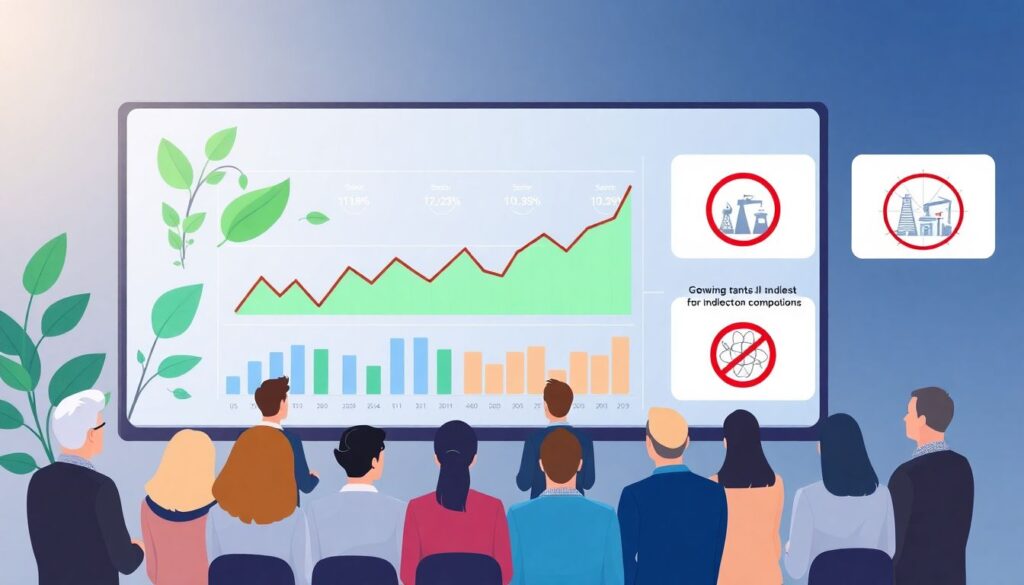
Another growing trend: customized indices and ETF portfolios that reflect:
– Environmental, social, and governance (ESG) considerations
– Religious or ethical constraints
– Sector exclusions (e.g., no fossil fuels, no weapons)
From a diversification perspective, many ESG or screened index funds still behave similarly to broad markets (sometimes with small differences in sector weights). Over the next decade, you can expect:
– More choice in “values‑aligned” index products
– Better data quality on ESG metrics
– Rising debate about long‑term performance impacts
For beginners, the key will still be to:
– Prioritize broad diversification and low cost
– Layer values and preferences on top of that, not instead of it
5. AI‑driven tools vs. human behavior
AI tools (like portfolio analyzers, risk simulators, and personalized projections) will keep improving. They can:
– Stress‑test your portfolio
– Model future scenarios
– Suggest allocation tweaks
But one thing won’t change:
The main risk is still emotional decision‑making.
Even with the best projections, the real challenge in a 30–40 year plan will be:
– Staying invested through downturns
– Rebalancing when markets are scary
– Increasing contributions as your income grows
In other words, the tech will evolve; the human discipline required will not.
Final Thoughts: Keep It Boring, Let Time Do the Heavy Lifting
You don’t need secret strategies or insider tips to build wealth.
You do need:
– A simple, diversified investment portfolio aligned with your goals and risk tolerance
– Low‑cost index funds as your core building blocks
– A plan for regular contributions and occasional rebalancing
– The patience to let compounding do what it has always done best
Among all the options in 2025, the approach that quietly works for the majority is still the same:
Own the market cheaply, stay diversified, ignore the noise, and give it time.