

Why downsizing your city life needs a serious budget game plan

Moving to a smaller city sounds like a financial detox: lower rent, less pressure, slower pace. But the real cost of moving to a smaller city is rarely as straightforward as “sell stuff, rent truck, live cheaper”. Вy 2025 we see a clear trend: many people leave big metros chasing affordability, and then get hit by hidden expenses — double housing payments during the overlap, deposits that freeze thousands of dollars, temporary Airbnb, loss of local support network, even higher car costs if public transit is weaker. A solid budget is less about “can I afford the move?” and more about “can I survive the first 6–12 months without panic and debt?”
Step one: calculate the real baseline, not the fantasy budget

Before even asking how much money to save before moving to a smaller city, you need two numbers: your actual current cost of living and a realistic forecast for the new place. Not idealized “if I cook every day”, but your true habits. Look at bank statements for 3–6 months: housing, transport, food, healthcare, subscriptions, social life. Then research the new city the same way a cautious investor studies a company: median rent by neighborhood, typical utility costs, internet, insurance, plus realistic transport (car, fuel, parking, or rideshares). Only after that you can model the new monthly budget and see if the gap is really that attractive or if you’re just trading Manhattan rent for higher commuting and car repair bills.
Real case #1: The “cheaper but not really” move
Anna and Mark left Seattle for a smaller city in Idaho in 2024, expecting to save at least 30% on living costs. Rent truly went down by $700 a month, but they underestimated everything else. They bought a second car because public transit was weak, took higher auto insurance due to different regional risks, and paid for frequent trips back to Seattle for work and family. For six months, they were paying both old and new rents due to a lease overlap and a delayed house sale. On paper, the move was rational; in practice, their cash flow was strained. Their lesson: planning the cost of moving to a smaller city must include transition chaos, not just the “steady-state” budget once everything settles.
Step two: build a move-specific budget, not just a monthly one
A lot of people use a generic budget app and think they’re done. Instead, assemble a dedicated budget planner for relocating to a new city with a timeline. You want a one-off cost map, not just a spreadsheet of recurring bills. Break the entire move into phases: preparation (documents, notices, deposits), logistics (packing, transport, storage), arrival (temporary housing, local registration, furniture), and stabilization (job search buffer, social setup, small emergencies). For each phase, assign a realistic cost range and a target savings goal. This approach reduces the risk of underfunding the noisiest phase — the first three months after arrival — when almost everything goes over the initial estimate and stress decisions become expensive ones.
Real case #2: Freeride on timing and negotiation
Jared moved from Chicago to a mid-sized city in North Carolina for remote work in early 2025. He started by requesting more flexible move-in dates from prospective landlords and talking openly about his remote job and long-term plans. One owner agreed to knock off half of the first month’s rent if he could move in during a “quiet” vacancy period. Jared then scheduled his move mid-week, off-peak for movers, which immediately dropped quotes by 15–20%. He also negotiated his offer with one of the best moving companies for long distance small city relocation by asking them to match a rival’s rate in exchange for a flexible loading window. Nothing here was magical — just calm, strategic timing and willingness to discuss constraints with providers instead of accepting the first price.
How much cash cushion is actually safe in 2025?
Online advice loves neat formulas: “3 months of expenses”, “6 months minimum”. For relocation, a blunt rule-of-thumb can be dangerous. The real question isn’t just how much money to save before moving to a smaller city, but how predictable your income and housing are after arrival. If you already have a signed job offer and confirmed lease, 3–4 months of full expenses (old city + new city overlap) may be adequate. If you’re switching careers, freelancing, or hunting for a job after arrival, pushing to 6–9 months of core living costs is more realistic. In 2025, job markets are volatile in many sectors, and small cities can have thinner labor markets, meaning each failed interview cycle might take longer to replace. Add a separate, ring-fenced “disaster buffer” equal to at least one month of expenses, never touched for predictable costs like movers or deposits.
Non-obvious budgeting tricks: treat time as a cost item
Many people budget only for visible money items: truck, boxes, deposit. A smarter approach is to see time as a financial variable. Time off work during the move, onboarding to a new job, delays in internet setup affecting remote work — all these can burn income as effectively as paying an extra bill. When planning the cost of moving to a smaller city, write down how many paid workdays you’ll effectively lose. Then monetize them using your typical daily net income. This subtle step frequently adds several hundred to several thousand dollars to the “true” relocation expense, especially for freelancers and remote employees who underestimate downtime and cognitive fatigue during the move.
Alternatives to traditional movers: when DIY makes sense — and when it doesn’t
One popular idea is to skip full-service movers in favor of cheap moving services for relocating to a smaller city, such as container-style pods, freight services, or hybrid self-pack options. These can work well if you’re not moving fragile antiques or a five-bedroom house. But the trade-off is your own time, stress, and potential injury risk. Analytical budgeting here means comparing cost per hour of your effort, not just invoice totals. If you’re a high-earning remote professional, two extra days of client work might be worth more than the additional fee for partial packing and loading services. On the other hand, for a student or someone in a career transition, sacrificing time to reduce invoices may be rational. The key is to price your time, health, and peace of mind explicitly instead of seeing them as “free resources”.
Alternative financial strategies: don’t fund the move from one bucket only
Relying solely on cash savings is simple, but not always optimal. Consider mixed strategies. For instance, temporarily increasing income for 6–12 months before the move (side gigs, overtime, seasonal work) and sending all incremental earnings to a dedicated relocation account. Another alternative is short-term geographic arbitrage: move in stages, first to a slightly cheaper neighborhood in your current city, cutting expenses early, then re-allocating those savings to the relocation fund. In 2025, some banks and employers offer relocation-linked products like low-interest personal loans, signing bonuses, or remote-work stipends. Instead of rejecting debt on principle, evaluate it strictly: effective interest rate vs. your expected income growth and the psychological weight of carrying that debt during adaptation in the new city.
Pro-level hacks for cutting move costs without cutting safety
Experienced movers and relocation consultants tend to follow a few quiet rules that regular people rarely use. First, they avoid moving during lease renewal peaks and college move-in periods when prices spike. Second, they declutter aggressively, but with a resale strategy rather than a last-minute donation binge: list high-value items months ahead on platforms with patient buyers to fund the move. Third, they lock in quotes from multiple providers early, then re-check rates 30–45 days before the date, sometimes re-negotiating if market demand has shifted. Another professional trick: ask about “flex loads” — time windows where movers can add your items to an already-scheduled route at a discount. This approach can shrink long-distance fees by a notable amount if your dates are flexible and you don’t mind a longer delivery window.
Numbered roadmap: turning chaos into a stepwise plan
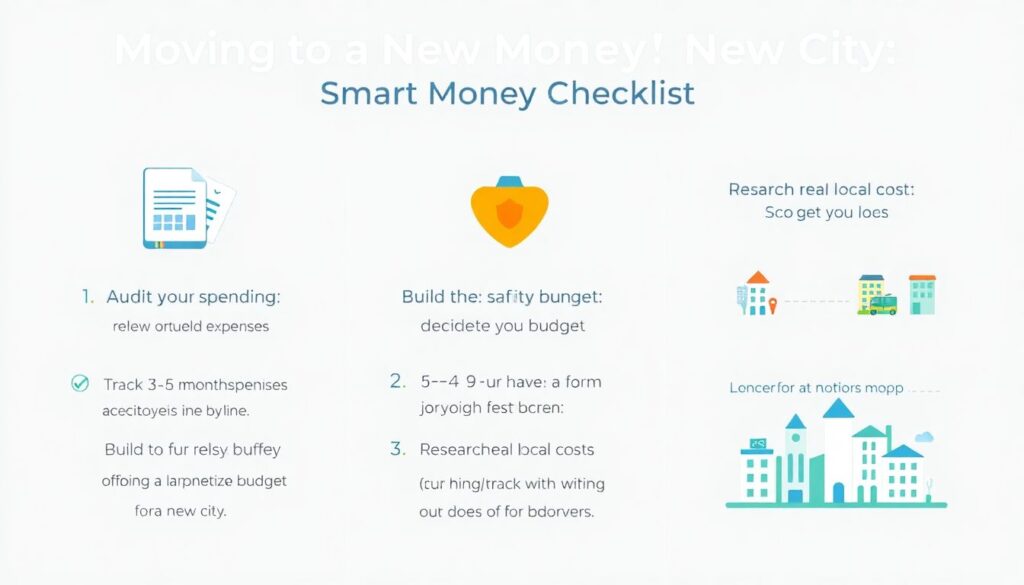
1. Audit 3–6 months of current expenses and build a realistic new-city budget, line by line.
2. Decide your risk level and set a target cash buffer (3–4 months with firm job and lease, 6–9 without).
3. Research housing, utilities, healthcare, and transport in at least three neighborhoods, not just the trendiest one.
4. Gather 3–5 quotes from movers, including both full-service and alternative options, and break out each cost element.
5. Create a move-specific savings plan with monthly targets and “no-touch” buffer rules, then track progress weekly.
Real case #3: Remote work, high uncertainty, smart buffers
Nora, a UX designer, left San Francisco for a smaller city in Colorado in 2025. Her fully remote job felt secure, but she assumed nothing: she factored in the risk that the company could later require partial office work in another region. She saved eight months of expenses, not because she expected disaster, but because she recognized how concentrated her income risk was. She also diversified clients by doing occasional freelance work, treating that as a real-time stress test of the new city’s connectivity and work environment. When a reorg cut her hours seven months after the move, she didn’t scramble; her buffer plus small freelance pipeline gave her a long runway, turning a potential crisis into a manageable adjustment.
Forecast to 2030: why relocation budgeting will only get more complex
By 2025 it’s clear that movement from megacities to smaller towns isn’t a fad; it’s a structural shift driven by remote work, housing costs, and lifestyle preferences. But smaller cities are evolving too: once-cheap locations are seeing rising rents, and some previously quiet places are now semi-famous “Zoom towns”. Over the next 5–7 years, expect relocation budgeting to hinge less on static cost-of-living comparisons and more on volatility: how quickly can housing prices spike, how dependent is the local economy on a few employers, how stable is your remote-work arrangement in a changing regulatory climate? Tools that today simply compare rents will increasingly model risk scenarios, and a good budget planner for relocating to a new city will look more like a lightweight financial plan with stress testing, not just a list of expenses. Those who treat their move like a multi-year financial strategy rather than a weekend logistics project will adapt faster, with fewer regrets — and more room to actually enjoy the quieter life they were chasing in the first place.