

Why Personal Finance Feels Different for Singles in 2025
Being single in 2025 is wildly different from being single even five years ago.
Remote work, freelance gigs, AI-powered banking apps, rising housing costs, crypto noise, and “buy now, pay later” everywhere — it’s a lot.
The upside?
You don’t have to negotiate money decisions with anyone. No partner to convince, no joint budget to argue over. Every choice — good or bad — is all yours.
That’s exactly why you need a simple, realistic system. Not a 40-page spreadsheet you’ll hate and abandon, but a setup you can manage on a busy Tuesday night.
This guide is a step‑by‑step roadmap for singles who want to get their money under control in 2025 without turning into a full-time finance nerd.
—
Step 1. Get Real About Your Numbers (No Shame, Just Data)
Track What’s Actually Going On
Before you ask how to budget money single person 2025 style, you need to know what’s happening with your cash right now. Not what you *think* is happening — what the numbers say.
For one full month, track:
– Every source of income (salary, bonuses, freelance, side hustles)
– Every expense (yes, including late-night food delivery)
– Every debt payment and subscription
You can use:
– Your banking app (most now auto-categorize spending with AI)
– A simple Google Sheet
– A dedicated budgeting app
The key: don’t judge yourself during this month. You’re just collecting data, like a scientist running an experiment.
Big Mistake to Avoid
Don’t guess.
Eyeballing your spending is why most people are “sure” they spend $200 on eating out and then discover it’s actually $600. Your brain lies; your bank statements don’t.
—
Step 2. Build a Simple, 2025-Proof Budget
Create a 3-Bucket Budget
Forget complex formulas. Start with three buckets:
1. Musts – rent, utilities, groceries, transport, insurance, minimum debt payments
2. Goals – savings, investments, emergency fund, big purchases
3. Fun – restaurants, travel, hobbies, streaming, gadgets
A classic starting point is:
– 50% Musts
– 30% Goals
– 20% Fun
But in many 2025 cities with brutal rent, your Musts might be closer to 60–65%. That’s okay. The point is to see where you are and then gradually nudge the numbers toward something healthier.
Automate So You Don’t Rely on Willpower
Once you decide how much goes into “Goals,” set up automatic transfers:
– Right after payday, move money into:
– Savings account (emergency fund)
– Investment account
– High-yield savings for short‑term goals (travel, moving, courses)
Automation is how you “win” on your lazy days. If the money moves itself, you’re less tempted to accidentally spend it.
Common Budgeting Traps for Singles
– “I’ll save whatever’s left at the end of the month.”
Spoiler: nothing will be left.
– Lifestyle inflation.
Every raise turns into nicer food, better Uber rides, more subscriptions — but zero extra savings.
– Confusing “I can afford the payment” with “I can afford the thing.”
BNPL and 0% installments make this worse in 2025. Watch total cost, not just the monthly bite.
—
Step 3. Build an Emergency Fund So You Can Sleep
Why Singles Need a Bigger Safety Net
When you’re single, there’s no second income to catch you if things go sideways — job loss, illness, surprise move, laptop dies, whatever. Your emergency fund *is* your backup partner.
Target:
– Starter goal: $1,000–$2,000 as fast as possible
– Main goal: 3–6 months of essential expenses
Not 3–6 months of your *entire* lifestyle. Just the Musts bucket.
Where to Keep It
Use a separate high-yield savings account, not your everyday checking account. Make it:
– Easy enough to access in a real emergency
– Inconvenient enough that you don’t “accidentally” dip into it for random shopping
And yes, those 2025 savings rates actually matter now. After years of near-zero interest, moving your stash to a better account can be free money.
—
Step 4. Deal With Debt Before It Eats Your Future
Line Up Every Debt You Have
Write down:
– Credit cards (with interest rates and balances)
– Student loans
– Personal loans or BNPL plans
– Car loans, overdrafts, anything you owe
Now sort them by interest rate, highest to lowest.
Choose Your Payoff Strategy
Two beginner‑friendly methods:
– Debt avalanche – pay extra toward the highest interest first; mathematically best
– Debt snowball – pay extra toward the smallest balance; psychologically motivating
If your motivation tends to crash quickly, snowball might keep you going longer, which often matters more than the pure math.
Red-Flag Moves to Avoid in 2025
– Rolling credit card debt into a personal loan and then racking up card debt again
– Treating “0% intro APR” cards as free money instead of temporary tools
– Using BNPL for non-essentials every week until your paycheck is sliced into 20 micro-payments
One rule that works:
If you wouldn’t buy it in full with cash, don’t finance it for months.
—
Step 5. Start Investing, Even With Tiny Amounts
Why You Can’t Wait “Until You Make More”
In 2025, investing is more accessible than ever, but also more distracting. Meme stocks, crypto hype, influencers showing insane returns — it’s easy to think you’re late to the party.
You’re not.
But you *are* late if you plan to “start later when I have more.” Time in the market still beats timing the market.
Simple Investment Setup for a Busy Single
Basic beginner blueprint:
– Open a brokerage account (or use your retirement account if available)
– Start with low-cost index funds or ETFs that track:
– The total stock market, or
– A broad index like the S&P 500
– Automate a fixed monthly contribution (even $50–$100 counts)
When you see shiny “investment tips for single professionals 2025” online, check whether they’re pushing you toward complex options you don’t understand. If you can’t explain an investment to a friend in 30 seconds, it’s probably not for you yet.
Risks and Myths to Watch Out For
– Myth: “I’ll wait for the perfect time to buy.”
No one knows. Even professionals mostly get timing wrong.
– Risk: Over-concentrating in trendy assets.
Crypto, AI stocks, whatever’s hot this month — fine as a small slice, dangerous as your whole portfolio.
– Myth: “Investing is just gambling.”
Buying random hype picks is gambling. Buying diversified funds and holding for 10–20 years is not.
—
Step 6. Don’t Ignore Retirement Just Because You’re Single
Future You Is Still Going to Show Up

You might not know where you’ll live, if you’ll have a partner, or what job you’ll have in 30 years. That’s normal.
You still need money when you stop working, and relying on government pensions or “I’ll figure it out later” is a bad strategy.
That’s where retirement planning for single adults 2025 becomes less about guessing your future and more about doing a few basic things consistently.
Quick Retirement Checklist
– If your employer offers a retirement plan with a match (401(k), etc.), contribute at least enough to get the full match. That’s free money.
– If no employer plan, open an IRA or local equivalent (depending on your country’s system).
– Invest in broad index funds and automate monthly contributions.
As your income grows, increase your contribution rate: 5% → 8% → 10% → 15%. Tiny changes add up if you start early.
—
Step 7. Use Tech Smartly: Tools That Actually Help
Picking the Right Tools, Not All the Tools
There are hundreds of money apps now — budgeting, investing, bill splitting, side hustles, AI financial coaches. Trying to use all of them is a part-time job.
Look instead for the best personal finance tools for singles 2025 that cover:
– Budgeting & cash flow tracking
– Automated savings
– Simple, low-fee investing
– Credit monitoring and alerts
You don’t need the fanciest thing; you need the one you’ll open weekly.
Low-Effort, High-Impact Tech Habits
– Turn on transaction notifications so weird charges don’t slip by
– Set bill reminders to avoid late fees
– Use subscription trackers to cancel stuff you forgot about
– Review your spending categories once a month — 10 minutes max
Remember: the best app is useless if you keep swiping away the notifications and never look at the dashboards.
—
Step 8. Upgrade Your Money Skills (Without Getting a Finance Degree)
Learn Just Enough to Be Dangerous (In a Good Way)
There’s an endless ocean of content in 2025: TikTok threads, YouTube breakdowns, podcasts, blogs, newsletters. Some are brilliant. Some are nonsense. Your job is to build a good filter.
One smart move is to take personal finance courses for singles online 2025 that:
– Are taught by qualified people (or at least transparent about who they are)
– Focus on fundamentals — budgeting, debt, investing, taxes
– Aren’t just a sales funnel into some expensive “premium group” or trading scheme
Signals to Trust vs. Signals to Run From
Trust more when:
– The advice sounds boring and consistent (diversify, automate, think long term)
– There’s clear disclosure of how the creator makes money
– They talk about risk and downside, not just upside
Run when:
– Returns are guaranteed
– There’s pressure to “get in now”
– You have to recruit others to make money
If someone is promising you a shortcut that sounds like a cheat code, assume you’re the product.
—
Step 9. Design a Money System That Fits Your Life, Not Someone Else’s
Single Life Has Its Own Money Patterns
As a single person, your money rhythms might look different:
– You might travel more
– You may support family members
– You might bounce between cities or jobs more frequently
– You often carry 100% of rent and bills
Your system should reflect that. It might mean:
– Bigger emergency fund than your coupled friends
– More saved for relocation and career changes
– A “fun & freedom” category you actually use — not just hoarding money out of fear
The goal isn’t to copy some influencer’s perfect budget. It’s to build a flexible structure that can bend when your life changes (and 2025 life changes fast).
—
Step 10. Make It Sustainable: Small Habits, Big Results
The 30-Minute Monthly Money Check-In
Once a month, grab a drink, open your apps, and do a quick review:
– Did you stay roughly within your budget buckets?
– Are your automatic transfers still running?
– Did your debt go down, stay the same, or creep up?
– Anything weird in your transactions?
This doesn’t need to be stressful. Think of it as a health check, not a courtroom.
Three Tiny Rules That Change Everything
– Rule 1: Pay yourself first.
Savings and investing happen right after payday, not “if there’s anything left.”
– Rule 2: Decide once, automate many times.
The fewer decisions you leave to willpower, the better you’ll do.
– Rule 3: Make upgrades gradual, not sudden.
When your income goes up, let your lifestyle go up slower than your savings rate.
—
Final Thoughts: You Don’t Need Perfect, You Need Consistent
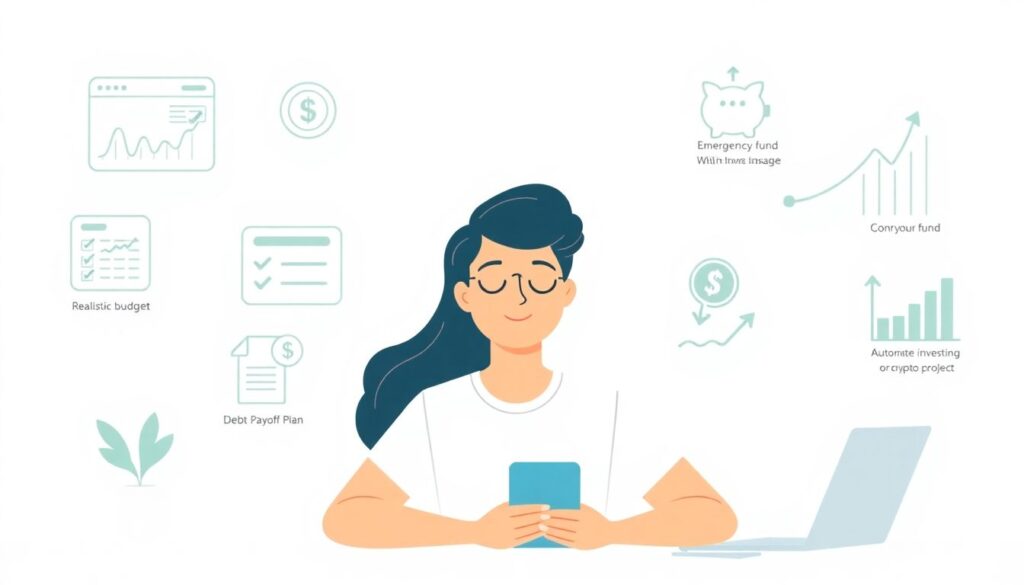
You don’t have to understand every market trend, every tax rule, or every crypto project. You just need:
– A clear picture of your money
– A simple budget that reflects reality
– An emergency fund
– A debt payoff plan
– Basic, automated investing for the long term
– A few tech tools that make it easier, not harder
Being single in 2025 gives you one massive advantage: you can turn the steering wheel anytime you want, without negotiating with anyone.
Use that freedom. Start small this month, tweak next month, keep going.
Your future self — single or not — will be very glad you did.