

Most people first meet their 401(k) on day three of a new job: a stack of HR forms, a vague mention of “free money,” and a box that asks how much of your paycheck you want to send into the void. This guide is meant to make that void less mysterious and more like a power tool you actually know how to use, so you can build the retirement you want instead of just hoping it sorts itself out someday.
—
Why 401(k) Contributions Feel So Confusing (But Don’t Have to Be)
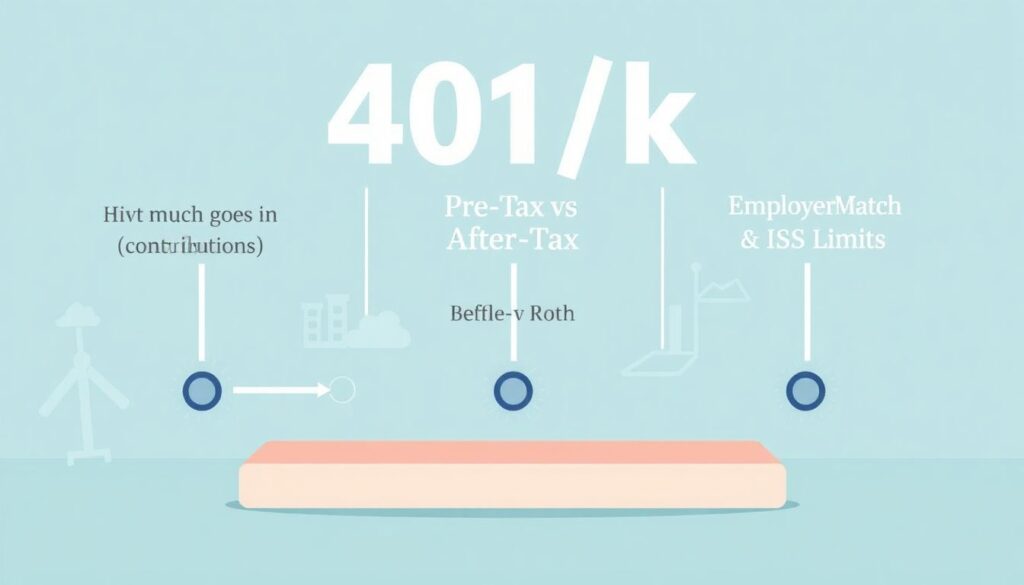
A 401(k) looks complicated because several moving parts hit you at once: pre‑tax vs after‑tax, the investment lineup, shifting IRS limits, and strange‑sounding “401k employer match rules and limits.” Underneath all that, though, your account is really driven by only three levers: how much goes in, when it goes in, and how heavily it’s taxed along the way. Once you understand those levers, you can start to see the best 401k contribution strategy for retirement for your own situation instead of copying whatever your co‑workers are doing and hoping they’ve secretly hired a financial planner.
—
“How Much Should I Contribute to My 401(k)?” – Three Real‑World Approaches
A surprisingly useful way to answer “how much should I contribute to my 401k” is to look at how different real people handle it, and what consequences they face later. Below are three simplified but realistic examples that show how strategy beats vague good intentions, especially when life doesn’t run in a straight line from age 25 to 65 with a steady paycheck and no drama.
1. The Minimum Match Hunter (Alex, 28)
Alex makes $60,000 and contributes just enough to get the full employer match: 4% of salary, matched 100%. It doesn’t sound heroic, but that’s already 8% of pay going in each year. When a surprise car repair hits, Alex doesn’t panic, because the contribution rate is still low enough that cash flow works. The trade‑off: Alex is building momentum slowly. This is a good “I’m just starting and I’m stressed about bills” strategy, but it needs to evolve within a few years or inflation and lifestyle creep will erode its impact.
2. The Aggressive Front‑Loader (Brianna, 34)
Brianna earns $110,000 and maxes out early in the year, front‑loading contributions to hit the IRS ceiling as soon as possible. She likes the psychological benefit of “getting it done,” and the money spends more time in the market. The downside is irregular paycheck size: her first few months feel tight, bonuses feel heavily “shrunk,” and if her employer’s match is calculated per pay period instead of annually, front‑loading can actually leave some match dollars on the table. It’s a powerful but advanced tactic that only works smoothly if you understand your employer’s specific mechanics.
3. The Lifestyle Balancer (Carlos, 40)
Carlos earns $85,000, has two kids, and feels squeezed. He wants to save more but also hates the idea of cutting everything fun. Instead of aiming for the max, he raises his 401(k) rate by 1% every six months and commits half of each raise to retirement. This slow‑ramp method takes advantage of human psychology: you don’t miss what you never saw in your checking account. Ten years later, Carlos is at a double‑digit contribution rate without ever feeling like he “went on a money diet,” and he still gets to travel with his family.
These three people show that the “right” answer to how much to contribute is less about one magic percentage and more about choosing a system you can actually stick with when life throws in job changes, childcare costs, or a tempting house upgrade.
—
Employer Match Rules, Limits, and Weird Edge Cases You Should Know
Employer contributions look simple on paper: “We’ll match 50% of your contributions up to 6% of pay.” But buried in that sentence are several levers that can either boost your savings or quietly reduce them if you’re not paying attention. Many 401k employer match rules and limits hinge on how often the match is calculated: per paycheck, quarterly, or annually. If it’s done per paycheck, aggressively front‑loading your own contributions in January might mean you hit the annual max early and then contribute nothing later in the year, so you miss match money on those later paychecks.
A less obvious twist is vesting. Some companies use a vesting schedule—say, 20% per year over five years—for the match. If you jump ship after three years, you may only keep 60% of the matched money. That doesn’t mean you should stay in a terrible job just for the vesting cliff, but it does mean that timing a career move by even a few months can be worth several thousand dollars. Another subtle trap: some employers impose their own caps separate from the IRS limits, especially for highly compensated employees. If you’re in a higher income bracket, it’s worth reading the plan document or asking HR outright whether you might face special testing or refunds if you contribute aggressively, so your “maxing out” plan doesn’t get partially undone at the end of the year.
—
Traditional vs Roth 401(k): Which Is Better Depends on *Future You*

Many plans now let you choose between traditional and Roth contributions, and the question traditional vs roth 401k which is better is not answered by a slogan like “Roth is always best for young people.” The real issue is whether your tax rate today is likely lower or higher than what it will be when you retire. With a traditional 401(k), you get a tax break now, but withdrawals in retirement are taxed as ordinary income. With a Roth 401(k), you pay tax now, but qualified withdrawals later are tax‑free. Each path shifts the timing of your tax pain.
A non‑obvious strategy is to *mix* both, especially if your income fluctuates year to year. For example, in a high‑income bonus year, you might lean heavily into traditional contributions to lower your current tax bill, while in a sabbatical year or a period of lower earnings, you tilt toward Roth because you’re paying those taxes at a cheaper rate. Another advanced move some professionals use: contribute to traditional 401(k) during your peak career years, then in an early‑retirement or semi‑retirement phase convert portions to Roth when your income (and tax bracket) temporarily drops. Instead of chasing one universally “best” answer, you’re building flexibility so that future‑you has more options when tax law and your life both inevitably change.
—
Navigating 401(k) Contribution Limits (Without Guessing or Hoping)
The IRS sets annual caps on how much you can stash in a 401(k), and they change over time with inflation. While you may see references to 401k contribution limits 2025 in financial news or plan brochures, the exact numbers can shift as the IRS updates guidance, so the only reliable approach is to check the latest IRS publication or your plan’s yearly notice rather than relying on outdated rules of thumb. What is consistent, however, is the structure: there’s a limit on how much *you* can contribute as an employee, and a separate, larger limit on the combined total of your contributions plus employer match and any additional employer deposits.
This distinction matters, especially if you’re a higher earner or work for a generous company. Imagine you’re contributing near the employee maximum and your employer suddenly bumps its match. Without adjusting your own pace, you might run into the combined limit well before December, leading your plan to cut off contributions or even issue a refund of what they call “excess contributions.” Those refunds are not only annoying paperwork; they can also complicate your taxes. A neat, under‑used tactic is to mark your calendar for a mid‑year “401(k) audit” where you check your year‑to‑date contributions, estimate the rest of the year, and tweak your percentage slightly so that you end the year right at the sweet spot—not a dollar short, and not a dollar over.
—
Alternative Methods When a 401(k) Alone Isn’t Enough
Relying only on your employer plan is like training just one muscle group at the gym. Powerful, yes, but not the whole picture. If your 401(k) has high fees, limited investment options, or no match, alternative methods can round out your best 401k contribution strategy for retirement and keep you from being locked into a mediocre plan. One common pairing is the 401(k) plus a Roth IRA: you contribute enough to the 401(k) to grab the full match, then direct extra savings to a Roth IRA where you may have lower‑cost investment choices and more flexible withdrawal rules. This mix is especially attractive if you anticipate a long life and want some tax‑free income later.
Self‑employed professionals or those with significant freelance income can add vehicles like a Solo 401(k) or SEP‑IRA to the mix, allowing large, tax‑advantaged contributions outside a traditional employer plan. Another alternative twist appears for people in high‑cost cities who are torn between maxing out 401(k) contributions and saving for a home down payment. A pragmatic compromise is to save at least the full match in the 401(k) and then focus heavily on a high‑yield savings or brokerage account earmarked for the down payment. The key idea: your retirement plan is an ecosystem, not a single account. By coordinating your 401(k) with IRAs, taxable investments, and even HSA contributions, you can balance long‑term growth with shorter‑term goals instead of choosing one and resenting the other.
—
Pro‑Level 401(k) Hacks That Don’t Require a Finance Degree
Professionals who squeeze the most value out of their 401(k)s often use a few less obvious tactics that go beyond “contribute more.” One powerful hack is using automatic escalation: most plans let you schedule a 1% or 2% increase in your contribution rate every year. Turning this on once and then forgetting about it harnesses inertia in your favor; in a few years you can move from 5% to 12% or more with minimal pain. Another is asset location thinking: instead of sprinkling the same funds everywhere, you intentionally hold tax‑inefficient investments like bond funds inside your 401(k), while keeping tax‑efficient index funds or ETFs in a taxable account. The overall portfolio matters more than each account in isolation.
A second tier of advanced moves includes understanding your plan’s withdrawal and loan rules before you’re under stress. If your 401(k) offers after‑tax contributions (not the same as Roth) plus in‑plan conversions, you may be able to use a “mega backdoor Roth” technique, but only if your employer’s administrative rules allow it and you’re well below the combined contribution caps. Another professional trick is to periodically compare your 401(k)’s fund options and expense ratios to those in low‑cost index funds elsewhere. If your plan is unusually expensive, you might deliberately keep just enough there to capture the match while directing additional long‑term investing to an IRA or brokerage account. The pattern in all these hacks is simple: move slowly, automate what you can, and use the rules of your specific plan as building blocks rather than as a rigid cage.
—
Understanding your 401(k) contributions is less about memorizing every regulation and more about learning how a few core choices—how much you put in, where taxes happen, and how you coordinate with the employer match—play out over decades. Once you view those decisions as adjustable levers instead of one‑time guesses, your retirement plan stops being an intimidating black box and starts to look like a machine you can actually tune to fit your life.
Комментарии