
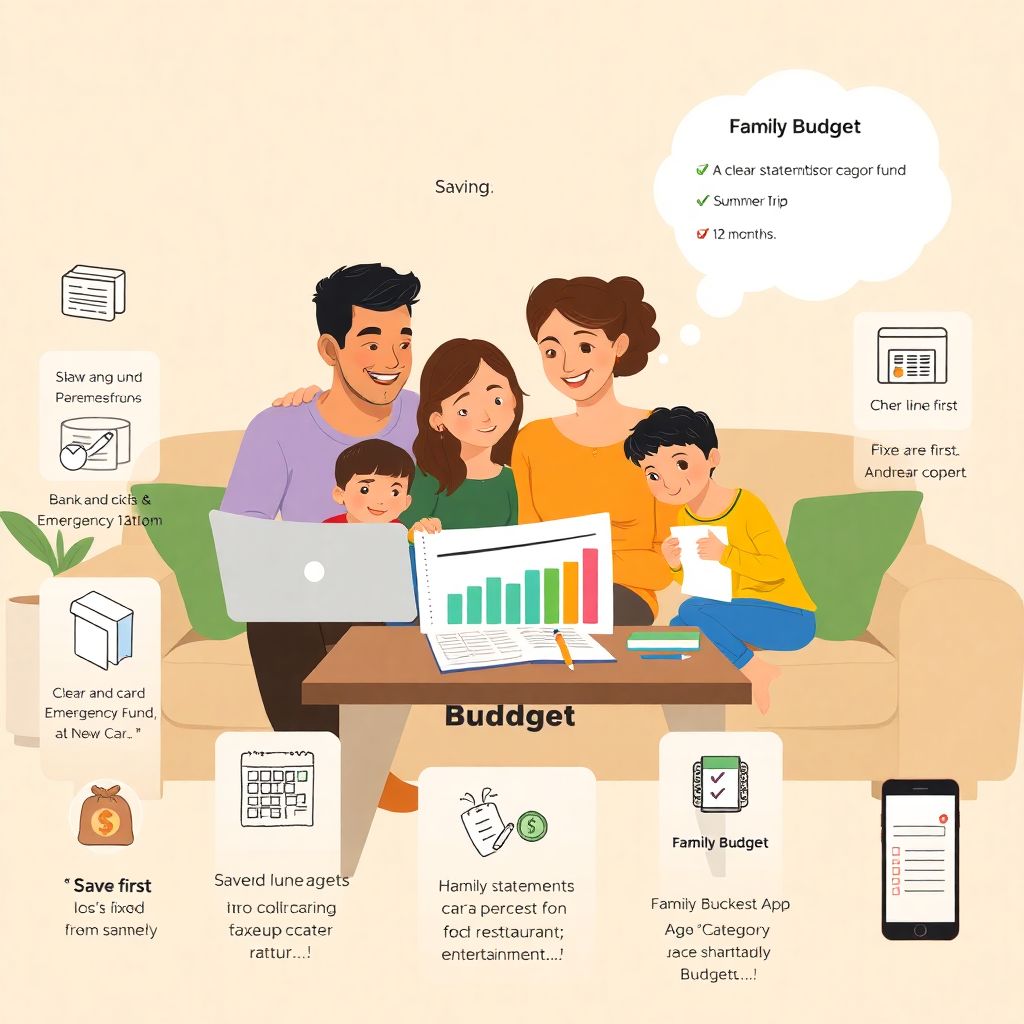
Most families don’t avoid budgeting because they’re lazy; they avoid it because previous attempts felt restrictive, confusing, or pointless. A budget that actually encourages saving works differently: it’s a plan that protects what matters to your family today while gradually building a buffer for tomorrow. Instead of tracking every coffee and arguing over receipts, your focus shifts to a few key numbers, clear agreements, and simple habits that run in the background. Below is a practical, no‑nonsense guide built on what financial planners, behavioral economists, and real families say actually works, including specific expert tips and realistic warnings about where people usually get stuck or give up too early.
Money conversations are emotional territory, so if things feel tense at first, that’s not a sign your family is “bad with money”; it’s a sign you’re doing real work together.
Step 1: Get clear on why your family wants to save

Before spreadsheets and apps, you need a shared purpose, otherwise the budget will start strong and quietly die in a month. Research on motivation shows that people stick with behavior change when the goal is vivid and personal, not abstract. So start by talking through what “saving” is supposed to do for your household: maybe it’s a six‑month emergency cushion, a down payment, reducing debt stress, or giving your kids more options. Be concrete. “Save more money” is vague; “build a $3,000 starter emergency fund in twelve months so car breakdowns don’t wreck us” is specific enough to steer choices. When each adult can see their own win in the plan — less anxiety, more freedom, fewer arguments — sacrifice stops feeling like punishment and starts feeling like progress.
Write these reasons down somewhere visible, even if it’s just a shared note on your phone.
Step 2: Map your real income and spending

Every expert I’ve interviewed or read agrees on one thing: you can’t build a useful budget on guesswork. Yet most families do exactly that, underestimating small recurring costs and overestimating how much “should” be left over. Instead of aiming for perfection, aim for an honest baseline. Pull the last two to three months of bank and card statements and sort spending into broad categories: housing, utilities, groceries, transport, subscriptions, debt payments, kids’ costs, medical, fun, and random “I forgot this existed” items. Don’t obsess over tiny details; your target is to see patterns and leaks, not to produce a forensic report. This exercise alone often reveals money going to things nobody really cares about — overlapping streaming services, unused gym memberships — which later becomes the easiest source of new savings without feeling deprived.
Expect surprises; they’re data, not a verdict on your self‑control.
Step 3: Design a saving‑first structure, not a restriction list
Now you have a baseline, flip the usual logic. Most people pay bills, spend, then see what’s left for saving; high‑saving households do the reverse. Decide on a realistic starting saving rate — even 3–5% of take‑home pay is fine if you’re new to this — and treat it as a non‑negotiable line item, like rent. From there, allocate for essentials (housing, food, utilities, transport, minimum debt), then assign caps for flexible categories like eating out, kids’ activities, and entertainment. Keep categories simple; five to eight is usually enough. Experts in behavioral finance emphasize that fewer decisions mean higher follow‑through. A straightforward rule like “We save $300 on the first of every month and keep restaurants under $200” is far more powerful than an elaborate system you abandon. As income changes, your saving percentage can grow, but it’s better to start modest and stick to it than to overpromise and resent the process.
Build in a small “no‑questions‑asked” personal money amount for each adult to reduce friction.
Step 4: Pick tools that do the heavy lifting for you

A family budget should not live in one person’s head or on a forgotten piece of paper. Use tools that match your style and tech comfort level. Many families do well starting with simple family budget templates for saving downloadable from reputable personal finance sites; these give structure without forcing you to invent formulas. If you’re phone‑first, look for the best family budgeting app for saving money that supports multiple users, shared goals, and automatic categorization of transactions. Features like alerts when you’re close to a category limit or visual progress bars toward savings targets tap into human psychology — we react better to immediate feedback than abstract numbers. Some people prefer to combine an app with occasional help from family budgeting services to get set up correctly, especially when income is irregular or there are multiple debts. The exact tool matters less than whether everyone who makes spending decisions can see the same numbers easily.
Whatever you choose, commit to using it for at least three full months before switching.
Step 5: Hold short, regular family money meetings
The budget isn’t a document; it’s an ongoing conversation. Without deliberate check‑ins, you will drift back to old habits even with perfect software. Schedule a 20–30 minute money meeting once a month, ideally on the same weekend, and treat it like any other important appointment. Agenda: look at last month’s numbers, compare them to your planned limits and savings goal, then adjust the upcoming month based on what’s actually happening in your lives. Keep the tone diagnostic, not accusatory: “We overspent on takeout; what made cooking hard? How can we plan around that?” rather than “You blew the restaurant budget again.” Experts in couples finance stress that process is as important as numbers: set ground rules like no blaming, one person speaks at a time, and decisions are made jointly. Over time, these meetings normalize money talk and turn the budget into a shared project instead of a source of conflict.
Include older kids for a few minutes so they see how decisions get made, in age‑appropriate language.
Step 6: Automate saving and protect your progress
Once your structure feels roughly right, automate as much as possible so your willpower is not constantly tested. Set an automatic transfer from checking to a separate savings account right after each paycheck hits; this “pay yourself first” move is one of the strongest habits experts recommend. If your bank allows it, nickname accounts based on goals — “Emergency Fund,” “Summer Trip,” “New Car” — to keep motivation concrete. For families carrying high‑interest debts, automation also works for extra payments, as long as the emergency fund is slowly growing too. Over time, you’ll want safeguards: alerts if balances drop too low, fraud protections, and maybe a modest buffer in checking so one odd week doesn’t force you to raid savings. As your situation gets more complex — business income, inheritance, special‑needs planning — it may be worth it to hire financial planner for family budget guidance, especially a fee‑only planner with fiduciary duty, to ensure your saving plan meshes with taxes, insurance, and long‑term goals.
Think of automation as building a system that keeps working even when you’re tired, stressed, or distracted.
Common mistakes that quietly kill saving
From client stories and research, the patterns are remarkably consistent. One major error is designing a budget around an ideal month rather than an average one, ignoring irregular but predictable expenses such as car maintenance, back‑to‑school shopping, annual subscriptions, or gifts. When these show up, families feel like they “failed,” even though the plan simply never accounted for reality. Another trap is relying on one partner as the sole money manager; if only one person knows what’s going on, resentment builds and the system falls apart when that person gets overwhelmed. Many beginners also obsess over tiny savings — driving across town to save a few dollars — while ignoring big levers like housing costs, insurance, or high‑interest debt. And finally, people give up after one messy month, assuming they’re not “budget types,” instead of recognizing that every new routine goes through a clumsy adjustment period before it feels natural.
If you expect these bumps, you’re more likely to treat them as feedback and revise the plan, not abandon it.
Beginner tips and expert recommendations for making it stick
Professionals who work in family finance repeatedly highlight a few practices that separate families who build lasting savings from those who cycle through budgeting apps every January. First, start embarrassingly small with your first target: a $500 or $1,000 emergency buffer is an entirely respectable first milestone if you’ve never had savings before. Hitting that goal quickly builds confidence and proves to your brain that saving is possible. Second, connect learning with action; an online family budget course for saving money can accelerate your progress, but it’s only useful if you implement one change each week instead of passively watching lessons. Third, choose a simple reward system: celebrate when you hit milestones in non‑financial ways, like a special family day that’s already budgeted or cooking a favorite meal at home. Some families also mix self‑education with occasional check‑ins from low‑cost family budgeting services or community workshops to sanity‑check their approach without committing to full‑time advisory relationships.
If you prefer to learn by doing rather than reading, use short experiments: try one new rule for 30 days, review the results, and keep only what helps.
Ultimately, the most effective family budget that encourages saving isn’t the most detailed or clever; it’s the one your household actually uses month after month. That means it fits your real lives, leaves room for joy, and evolves as your circumstances change. By grounding your plan in clear reasons, honest numbers, simple tools, regular conversations, and modest but steady automation, you turn saving from a vague aspiration into something your family does almost on autopilot — quietly, consistently, and with much less stress than you might expect right now.