
Why Refinancing Feels Different in 2025
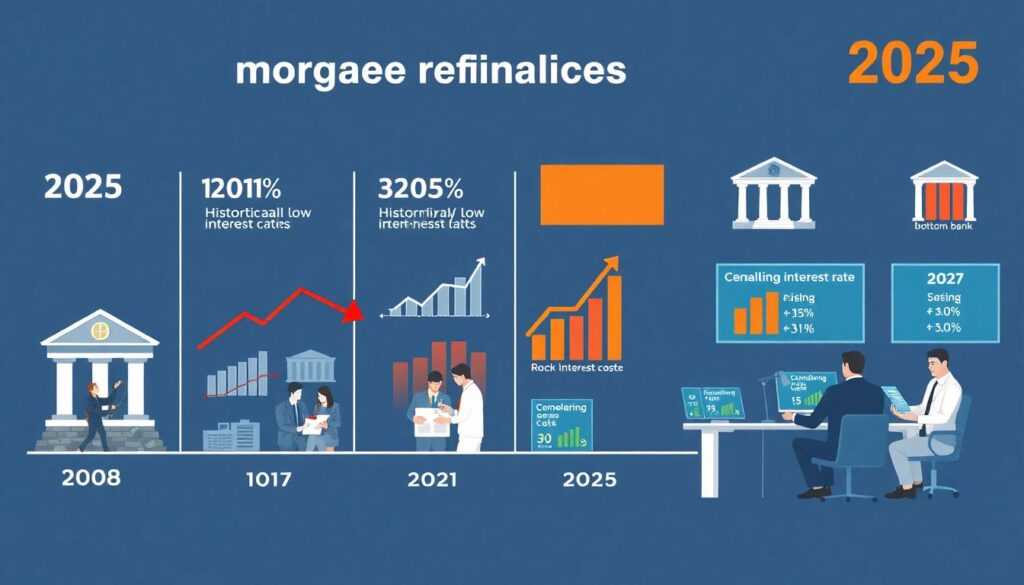
In 2025, refinancing a mortgage is a very different game than it was a decade ago. After the 2008 crisis, central banks kept rates historically low, and between 2020–2021 many borrowers locked in rock‑bottom deals. Then inflation surged, policymakers hiked aggressively, and mortgage costs jumped in a way not seen since the late 1970s–1980s cycle. That older era showed what happens when households misjudge rising borrowing costs: payment shocks, forced sales, and negative equity. Today, lenders model risk more carefully, regulators demand stress testing, and borrowers must treat a refi not as a casual “rate update,” but as a capital‑structure decision that needs data, discipline, and clear scenarios for income, housing plans, and macroeconomic uncertainty.
Reading the Rate Landscape Before You Move
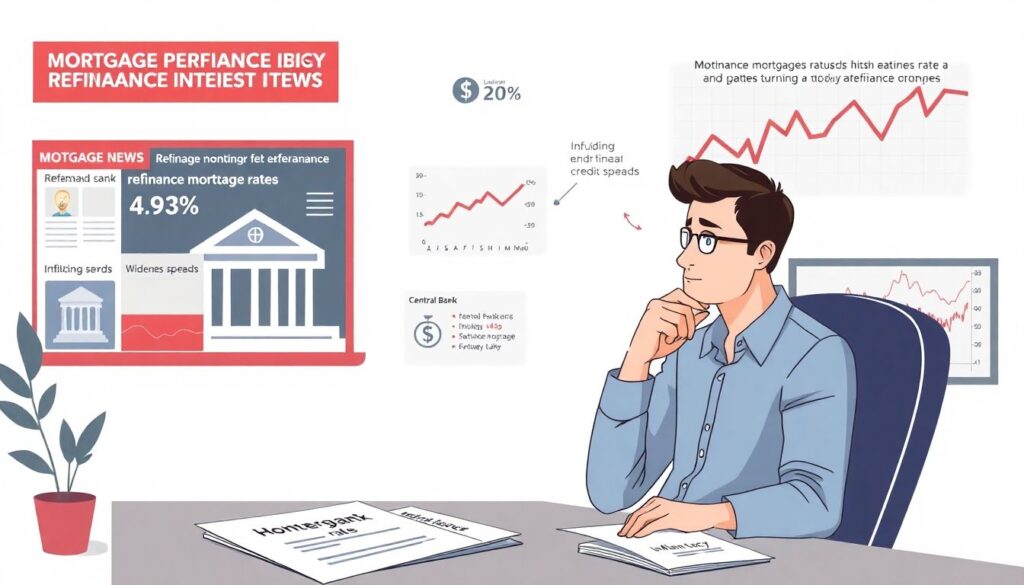
Before you think about how to refinance mortgage with high interest rates, it helps to decode what you’re seeing in the headlines. The advertised refinance mortgage rates today reflect not just central bank policy, but also inflation expectations, credit spreads, and the cost of long‑term funding in bond markets. In a rising‑rate environment, lenders tend to price in extra risk premiums for longer fixed terms, making short fixed periods or adjustable‑rate structures look deceptively cheaper up front. The technical task for a borrower is to translate those quoted percentages into cash‑flow impacts over time, running sensitivity analysis on scenarios like “rates stay elevated,” “rates fall moderately,” or “rates spike again,” and judging which path your own budget can tolerate.
Essential Tools and Data You Need
Going in unprepared is how people repeat the mistakes of past cycles, so assemble a small toolkit. At minimum, you need current statements for your existing loan, documentation of income and liabilities, and a detailed monthly cash‑flow breakdown. Next, use several amortization and break‑even calculators to model interest savings versus closing costs, ideally on platforms that let you compare mortgage refinance rates online rather than relying on a single bank’s marketing pitch. Add a credit‑monitoring service or credit‑report pull so you know your exact FICO or equivalent; in 2025, pricing grids are highly sensitive to credit tiers. Finally, keep a running spreadsheet to test alternative term lengths, points, and rate options, translating abstract percentages into net present value and internal rate of return on the refinance decision.
Choosing the Right Lender in a Crowded Market
The universe of lenders has expanded since the early 2010s, with non‑bank originators, fintech platforms, and traditional banks competing for volume, but not all carry the same execution quality. When you hunt for the best mortgage refinance lenders, look beyond teaser APRs and check secondary metrics: rate‑lock policies, turn‑time statistics, re‑disclosure practices, and historical fallout rates on locked loans. Regulators learned after 2008 that sloppy underwriting fuels systemic risk, so underwriting overlays, documentation requests, and appraisal standards have all stiffened. That means the “easiest” lender is not always the one that will actually close on the terms you expect. Reading third‑party performance data, regulator enforcement actions, and user reviews focused on closing accuracy is more important than chasing the last 0.05% on nominal rate quotes.
Step 1: Define Your Objective in Financial Terms
A refinance only makes sense relative to a precise objective. In the low‑rate era, “lower my payment” was enough; in a rising‑rate setting you must specify whether you’re optimizing for lifetime interest cost, monthly liquidity, debt‑paydown speed, or equity extraction. For instance, someone who locked a very cheap loan in 2021 might now focus on restructuring term length without materially improving rate, while another borrower may want to consolidate higher‑rate consumer debt via cash out refinance mortgage offers. Translate each objective into quantifiable metrics: target payment band, maximum acceptable total interest over remaining horizon, and required cash at closing. With those constraints expressed numerically, it becomes easier to dismiss flashy offers that look attractive but don’t improve your defined outcome.
Step 2: Model Scenarios and Collect Offers
Once objectives are clear, request preliminary quotes from multiple lenders within a tight time window so hard‑pull inquiries are treated as a single shopping event by credit bureaus. Use your tools to normalize these proposals: same loan amount, same points, same lock period. Because refinance mortgage rates today can move day‑to‑day with bond‑market volatility, focus on structure rather than chasing tiny intraday dips. Build three or four detailed scenarios—shorter term at similar rate, same term with rate buydown, slightly higher rate with lower fees—and calculate break‑even periods for each. Include sensitivity analysis to stress how rate resets or prepayment could change the economics. This method mirrors how institutional borrowers evaluate funding options in volatile markets, bringing discipline to a retail‑level decision.
Step 3: Lock, Underwrite, and Monitor Execution Risk
After you choose a structure, locking your rate is effectively a hedge against further market moves. In a rising‑rate environment, longer lock periods can be expensive, but extension fees may be worse if the lender’s pipeline is congested. Scrutinize the lock agreement: conditions under which the lender can reprice, allowable property‑value changes, and documentation thresholds. During underwriting, respond quickly to conditions; delays increase the odds that your lock will expire or that the lender will invoke change‑of‑circumstance rules. Track appraisal scheduling, title work, and closing‑disclosure timelines like a project manager. This is where many borrowers in past cycles lost favorable offers—not because markets moved, but because execution risk wasn’t actively controlled.
How Rising Rates Change Cash‑Out Decisions
Historically, cheap credit encouraged aggressive equity tapping, which amplified vulnerability when housing prices corrected, as seen in 2006–2010. In 2025, using home equity still can be rational, but the hurdle rate is higher. When evaluating modern cash out refinance mortgage offers, compare the blended cost of shifting unsecured or shorter‑term debt into a longer mortgage against alternatives like targeted amortization, balance transfers, or personal loans. Since you’re likely trading a lower legacy mortgage rate for a higher blended rate, calculate the incremental interest cost attributable purely to the cash‑out component. Also, consider regulatory caps on loan‑to‑value ratios and how a potential property‑price decline would affect your exit options if you needed to sell or refinance again in a less favorable cycle.
Troubleshooting Common Problems and Red Flags
Several issues tend to derail refinances when rates are rising. Appraisals can come in below expectations if the local market has cooled, eroding your equity cushion and triggering pricing hits or denial; in that case, challenge factual errors in the report or reduce the requested loan amount. Debt‑to‑income ratios may tighten if variable‑rate debts have already repriced upward; mitigate this by paying down revolving balances or restructuring car and personal loans in advance. If your lender suddenly re‑quotes far above earlier indications, revisit your ability to compare mortgage refinance rates online with competitors rather than accepting the change as inevitable. Any pressure to skip detailed disclosures, rush signatures, or avoid written confirmations is a signal to slow down and, if needed, walk away.
Learning from Past Cycles to Future‑Proof Your Loan
History shows that rate cycles are exactly that—cyclical. The ultra‑low regime after 2008 led many to assume cheap money was permanent; the rapid hikes in the early 2020s broke that illusion much like the Volcker‑era shocks did decades earlier. When structuring a refinance now, design it so you don’t rely on future rate cuts to remain solvent. That usually means stress‑testing your payment at higher hypothetical rates, avoiding excessive leverage, and keeping flexibility to prepay or refinance again if the curve normalizes. Building an emergency fund and maintaining strong credit quality are still the most robust hedges against macro volatility. In other words, use the refinance not just to solve today’s problem, but to harden your household balance sheet for whatever the next cycle brings.